Physical Address
304 North Cardinal St.
Dorchester Center, MA 02124
Physical Address
304 North Cardinal St.
Dorchester Center, MA 02124

Vitamin D for healthy aging is one of the most researched topics in preventive health, and for good reason. Although commonly known as the “sunshine vitamin,” vitamin D functions more like a hormone than a traditional vitamin, influencing hundreds of biological processes throughout the body.
As we age, maintaining adequate vitamin D levels becomes increasingly important. Healthy levels are associated with stronger bones, better muscle function, immune system support, and overall physical performance. Because aging naturally reduces the body’s ability to produce vitamin D from sunlight, many adults over 50 are at greater risk of deficiency.
While vitamin D is not a miracle supplement, ensuring adequate levels is an important part of a healthy aging strategy. Combined with regular physical activity, a balanced diet, quality sleep, and preventive healthcare, it can help support long-term health and independence.
Vitamin D is a fat-soluble vitamin that helps regulate calcium and phosphorus, two minerals essential for maintaining healthy bones and muscles.
Unlike most vitamins, vitamin D can be produced naturally when the skin is exposed to ultraviolet B (UVB) rays from sunlight. It is also obtained from certain foods and dietary supplements.
The two primary forms are:
Vitamin D2 comes primarily from plant-based sources and fortified foods. It can help increase vitamin D levels but is generally considered less effective than vitamin D3 at maintaining those levels over time.
Vitamin D3 is produced naturally in the skin after sun exposure and is also found in animal-based foods and supplements. It is the form most commonly recommended for supplementation because it raises and maintains blood vitamin D levels more efficiently.
After entering the body, both forms are converted into their active form through processes involving the liver and kidneys, allowing vitamin D to support multiple organs and systems.
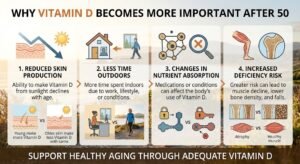
Vitamin D needs become increasingly relevant with age for several reasons.
As the skin ages, its ability to produce vitamin D from sunlight gradually declines. Even with the same amount of sun exposure, older adults typically produce less vitamin D than younger individuals.
Many adults spend more time indoors due to work, retirement, health conditions, or lifestyle habits. Reduced sun exposure further limits natural vitamin D production.
Certain medical conditions and medications can affect the body’s ability to absorb or metabolize vitamin D, increasing the risk of inadequate levels.
Vitamin D deficiency becomes more common after the age of 50 and may contribute to reduced muscle function, lower bone density, and an increased risk of falls and fractures.
Because of these age-related changes, maintaining adequate vitamin D levels becomes an important part of supporting healthy aging.
Although vitamin D is best known for its role in bone health, it also plays an important role in muscle function.
Vitamin D receptors are present in skeletal muscle, suggesting that the vitamin contributes to muscle performance and physical function.
Research indicates that maintaining healthy vitamin D levels may help support:
For older adults, these benefits are especially important because muscle weakness is a major contributor to falls and loss of independence.
Vitamin D alone cannot prevent age-related muscle loss, but it works best as part of a comprehensive strategy that includes resistance training, adequate protein intake, and an active lifestyle.
Learn more about preserving muscle as you age in our article:
Strength Training After 50: The Best Routine for Healthy Aging
You can also read our complete guide to:
Sarcopenia: Symptoms, Causes, Prevention, and the Best Ways to Preserve Muscle After 50
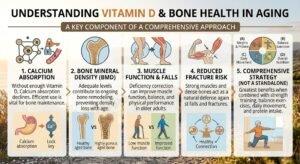
One of vitamin D’s most established roles is helping the body absorb calcium efficiently.
Without enough vitamin D, calcium absorption decreases, making it more difficult to maintain strong bones.
Healthy vitamin D levels help support:
Vitamin D improves the body’s ability to absorb calcium from food, helping maintain healthy bones throughout life.
Maintaining adequate vitamin D contributes to bone remodeling and helps preserve bone mineral density as people age.
Strong muscles and healthy bones work together to reduce the risk of falls and fractures, which become increasingly common in older adults.
Although vitamin D is an important part of bone health, it works alongside other factors, including regular weight-bearing exercise, sufficient dietary calcium, and overall good nutrition.
Falls are one of the leading causes of injury among older adults.
Research suggests that correcting vitamin D deficiency may improve muscle function in individuals with low vitamin D levels, which could contribute to better balance and physical performance.
However, vitamin D should not be viewed as a standalone solution. The greatest benefits are achieved when adequate vitamin D levels are combined with:
A comprehensive approach is far more effective than relying on any single supplement.
Vitamin D also plays an important role in supporting the immune system.
Vitamin D receptors are found in many immune cells, where they help regulate both the innate and adaptive immune responses. Rather than simply “boosting” immunity, vitamin D helps the immune system function properly and maintain a balanced inflammatory response.
Research suggests that maintaining adequate vitamin D levels may support:
While vitamin D is essential for immune health, supplementation should not be viewed as a substitute for other healthy habits such as regular exercise, a nutritious diet, quality sleep, and recommended vaccinations.
Healthy aging involves preserving physical function, maintaining independence, and reducing the risk of chronic disease.
Vitamin D contributes to several systems that influence healthy aging, including:
However, it is important to keep expectations realistic.
Current research does not support vitamin D as a “longevity supplement” capable of extending lifespan on its own. Instead, maintaining adequate vitamin D levels helps support normal physiological functions that contribute to aging well.
Think of vitamin D as one piece of a much larger healthy aging strategy.
Vitamin D requirements vary depending on age, health status, geographic location, skin pigmentation, and sun exposure.
General recommendations suggest that adults over 50 should ensure they meet their daily vitamin D needs through a combination of sunlight, food, and supplements when appropriate.
Some individuals may require higher amounts under medical supervision, particularly if blood tests confirm a deficiency.
Because excessive vitamin D intake can also be harmful, supplementation should ideally be guided by a healthcare professional based on individual needs.
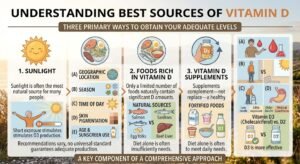
There are three primary ways to obtain vitamin D.
For many people, sunlight is the most natural source of vitamin D.
Short periods of sun exposure may help stimulate vitamin D production, although the amount produced depends on factors such as:
Because recommendations vary widely based on individual circumstances, there is no universal amount of sun exposure that guarantees adequate vitamin D production.
Only a limited number of foods naturally contain significant amounts of vitamin D.
Good dietary sources include:
Many countries also fortify foods such as:
Although these foods contribute to vitamin D intake, diet alone is often insufficient to meet daily needs.
Vitamin D supplements may be appropriate for individuals who:
Vitamin D3 (cholecalciferol) is generally the preferred form because it is more effective at maintaining blood vitamin D concentrations than vitamin D2.
Supplements should complement—not replace—a healthy lifestyle.
Vitamin D deficiency is relatively common worldwide.
Groups at higher risk include:
Because deficiency often develops without obvious symptoms, blood testing may be appropriate for individuals at higher risk or when recommended by a healthcare provider.
Not everyone needs a vitamin D supplement.
For some people, regular sun exposure and a balanced diet may provide adequate amounts.
However, supplementation may be beneficial for individuals who:
The decision to supplement should ideally be based on individual circumstances rather than assumptions.
Vitamin D supports bone health, muscle function, immune regulation, and physical performance, making it an important nutrient for healthy aging.
Both forms increase vitamin D levels, but vitamin D3 is generally more effective at maintaining adequate blood concentrations over time.
Maintaining adequate vitamin D levels supports normal muscle function. When combined with resistance training and proper nutrition, it can contribute to better physical performance.
Some people can meet their vitamin D needs through sun exposure, but factors such as age, season, skin pigmentation, geographic location, and lifestyle greatly influence production.
Some adults over 50 may benefit from daily supplementation, particularly if they have low vitamin D levels or limited sun exposure. The appropriate dose should be determined with the guidance of a healthcare professional.
Vitamin D is one of the most important nutrients for supporting healthy aging.
Although it is often associated with bone health, its role extends far beyond the skeleton. Adequate vitamin D levels contribute to healthy muscle function, immune regulation, balance, and overall physical performance.
At the same time, vitamin D is not a miracle solution. The greatest benefits come when adequate vitamin D levels are combined with regular strength training, sufficient protein intake, quality sleep, and an active lifestyle.
Healthy aging is built on consistent daily habits—not a single supplement.
If you are building a long-term strategy for longevity, vitamin D deserves a place alongside evidence-based nutrition, exercise, and preventive healthcare.
• Holick MF. Vitamin D Deficiency. New England Journal of Medicine. 2007.
Read the study → https://pubmed.ncbi.nlm.nih.gov/18029940/
• Bischoff-Ferrari HA, et al. Fall prevention with supplemental and active forms of vitamin D: a meta-analysis of randomised controlled trials. BMJ. 2009.
Read the study → https://pubmed.ncbi.nlm.nih.gov/19797342/
• Bouillon R, et al. Vitamin D and Human Health: Lessons from Vitamin D Receptor Null Mice. Endocrine Reviews. 2008.
Read the study → https://pubmed.ncbi.nlm.nih.gov/18279084/
• National Institutes of Health. Vitamin D Fact Sheet for Health Professionals.
Read the resource → https://ods.od.nih.gov/factsheets/VitaminD-HealthProfessional/

The Live Ever Better Editorial Team is dedicated to publishing evidence-based content that helps adults over 50 achieve healthier aging and greater longevity. Every article is carefully researched using scientific studies, clinical guidelines, and trusted health organizations to ensure accurate, practical, and reliable health information.