Physical Address
304 North Cardinal St.
Dorchester Center, MA 02124
Physical Address
304 North Cardinal St.
Dorchester Center, MA 02124

Many adults begin experiencing sleep problems after age 50. Falling asleep becomes harder, nighttime awakenings become more frequent, and waking up feeling refreshed often seems impossible.
Because of this, many people start looking for the best magnesium for sleep after 50. Magnesium supplements have become increasingly popular, with claims that they promote deeper sleep, reduce nighttime muscle cramps, lower stress, and improve overall recovery.
But not all magnesium supplements are the same.
There are several forms—including glycinate, citrate, oxide, malate, and threonate—and each behaves differently inside the body. Some are absorbed more efficiently, some primarily support digestion, while others appear more beneficial for relaxation and sleep.
Choosing the best magnesium for sleep after 50 means understanding these differences instead of simply buying the first product on the shelf.
In this evidence-based guide, you’ll learn how magnesium influences sleep, compare the most common forms, understand who may benefit from supplementation, and discover which type is most appropriate for healthy aging.
Magnesium participates in more than 300 enzymatic reactions throughout the body.
It plays essential roles in:
As we age, several factors may contribute to lower magnesium status, including:
These changes help explain why finding the best magnesium for sleep after 50 has become an important topic in healthy aging.
Magnesium is not a sleeping pill.
Instead, it supports several biological systems involved in healthy sleep.
Research suggests magnesium may help by:
For people with low magnesium intake or mild deficiency, supplementation may improve sleep quality, shorten the time needed to fall asleep, and reduce nighttime awakenings.
However, magnesium works best when combined with healthy lifestyle habits rather than used as a standalone solution.
If you’re looking for the best magnesium for sleep after 50, remember that sleep hygiene remains the foundation.
Continue reading:
A true magnesium deficiency is uncommon but can occur.
More frequently, adults consume less magnesium than recommended without developing obvious symptoms.
Possible signs include:
These symptoms are non-specific and can have many causes, so they should not be used alone to diagnose magnesium deficiency.
Even so, people searching for the best magnesium for sleep after 50 often experience one or more of these complaints.
Not all magnesium supplements are created equal.
The mineral is bound to different compounds, affecting absorption, tolerability, and potential health benefits.
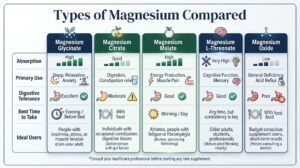
Magnesium glycinate combines magnesium with the amino acid glycine.
It is:
Because glycine itself has calming properties, magnesium glycinate is widely regarded as the best magnesium for sleep after 50.
Magnesium citrate is also well absorbed.
However, it has a mild laxative effect and is frequently used to relieve constipation.
Although some people sleep well after taking citrate, it is generally chosen for digestive support rather than insomnia.
Magnesium malate contains malic acid, a compound involved in cellular energy production.
It is often marketed for:
Some people prefer taking malate during the daytime because of its potential energizing effects.
Magnesium L-threonate is unique because it appears to cross the blood-brain barrier more efficiently than other forms.
Researchers continue investigating its possible role in:
Although promising, current evidence remains more limited than for glycinate.
Magnesium oxide is inexpensive but poorly absorbed.
It is commonly used as a laxative and generally is not considered the best choice for improving sleep.
When comparing all available forms, magnesium glycinate consistently stands out as the best magnesium for sleep after 50 for most healthy adults.
Why?
Because it offers an excellent balance of:
That doesn’t mean glycinate is the “best” magnesium for every purpose.
Different forms serve different clinical goals.
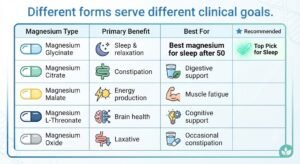
If your primary concern is improving sleep quality, relaxation, and nighttime recovery, magnesium glycinate is generally considered the best magnesium for sleep after 50 according to current evidence.
The Recommended Dietary Allowance (RDA) for magnesium is:
It’s important to note that these values refer to total daily magnesium intake from both food and supplements.
Many people can meet much of their magnesium needs through foods such as:
Supplements should complement—not replace—a balanced diet.
There is no single “perfect” time.
However, for people using the best magnesium for sleep after 50, most sleep specialists recommend taking it:
This timing allows magnesium to become available as your body prepares for sleep.
Consistency matters more than the exact clock time.
Taking magnesium at approximately the same time every evening helps establish a regular routine.
For most healthy adults, yes.
Daily magnesium supplementation is generally considered safe when:
Because magnesium is involved in hundreds of biological processes, maintaining adequate intake every day is far more beneficial than taking large amounts occasionally.
Magnesium is generally well tolerated.
Possible side effects depend on the specific formulation.
The most common include:
These effects occur more frequently with:
Magnesium glycinate is usually much gentler on the digestive system, which is another reason it is frequently recommended as the best magnesium for sleep after 50.
Although magnesium is safe for most people, supplementation may not be appropriate for everyone.
Consult your healthcare provider before taking magnesium if you:
Magnesium can interact with several medications by reducing their absorption.
Spacing supplements and medications by several hours often helps minimize these interactions, but individualized medical advice is important.

Even the best magnesium for sleep after 50 cannot compensate for poor sleep habits.
To maximize results:
Magnesium works best as part of a comprehensive healthy-aging strategy.
You may also benefit from:
Current evidence suggests that magnesium glycinate is the best magnesium for sleep after 50 because it combines excellent absorption with calming properties and minimal digestive side effects.
Some people notice improvements within several days, while others may require two to four weeks of consistent use. Results vary depending on overall magnesium status, lifestyle, and the underlying cause of sleep difficulties.
For sleep, yes.
Magnesium glycinate is generally preferred because it is less likely to cause diarrhea and is better suited for promoting relaxation.
Magnesium citrate is more commonly used to relieve constipation.
No.
Magnesium should not be considered a substitute for prescribed sleep medications. Instead, it may serve as one component of a broader strategy to improve sleep quality naturally.
For most healthy adults, yes.
There is no evidence that magnesium and creatine interact negatively. In fact, both supplements may complement resistance training, muscle recovery, and healthy aging when used appropriately.
Learn more in:
Choosing the best magnesium for sleep after 50 isn’t about finding a miracle supplement—it’s about selecting the right tool to support healthy sleep as part of a broader healthy-aging strategy.
Current scientific evidence suggests that magnesium glycinate is the best magnesium for sleep after 50 for most adults because it combines excellent absorption, gentle digestive tolerance, and calming properties that may help support relaxation and better sleep quality.
However, magnesium is most effective when paired with healthy lifestyle habits. No supplement can replace the benefits of regular physical activity, balanced nutrition, consistent sleep routines, stress management, and maintaining a healthy body weight.
If you’re struggling with poor sleep, frequent nighttime awakenings, or restless muscles, choosing the best magnesium for sleep after 50 may become a valuable part of your routine—but it should complement, not replace, healthy daily habits.
Healthy aging isn’t built on one supplement.
It’s built on hundreds of small decisions made consistently over time.
And when those habits work together, better sleep often becomes one of the first noticeable rewards.
The information provided in this article is for educational purposes only and should not be considered medical advice. Always consult a qualified healthcare professional before starting, stopping, or changing any supplement, medication, diet, or exercise program. Magnesium supplements may interact with certain medications and may not be appropriate for people with kidney disease or other medical conditions.

The Live Ever Better Editorial Team is dedicated to publishing evidence-based content that helps adults over 50 achieve healthier aging and greater longevity. Every article is carefully researched using scientific studies, clinical guidelines, and trusted health organizations to ensure accurate, practical, and reliable health information.