Physical Address
304 North Cardinal St.
Dorchester Center, MA 02124
Physical Address
304 North Cardinal St.
Dorchester Center, MA 02124

Magnesium for healthy aging has gained growing attention as researchers continue to uncover its role in supporting hundreds of essential biological processes throughout the body.
Often overlooked compared to nutrients such as vitamin D or calcium, magnesium is involved in muscle function, nerve signaling, energy production, heart rhythm, and bone health. Because magnesium intake tends to decline with age—and the body’s ability to absorb and retain it may also change—many adults over 50 may not consume enough of this essential mineral.
Although magnesium is not a miracle supplement, maintaining adequate levels is an important part of an evidence-based strategy for healthy aging. Combined with regular exercise, balanced nutrition, quality sleep, and preventive healthcare, magnesium helps support the body’s ability to function efficiently throughout life.
Magnesium is an essential mineral required for more than 300 enzymatic reactions in the human body.
Nearly every organ depends on magnesium to function properly.
It contributes to:
Approximately 50–60% of the body’s magnesium is stored in bones, while the remainder is found in muscles and other soft tissues.
Because the body cannot produce magnesium on its own, it must be obtained regularly through food or, when appropriate, dietary supplements.
As we age, maintaining healthy magnesium levels becomes increasingly important.
Several factors may contribute to lower magnesium status in older adults.
Many adults consume fewer magnesium-rich foods than recommended.
Highly processed foods often contain significantly less magnesium than whole foods such as vegetables, legumes, nuts, and seeds.
Aging may affect how efficiently the digestive system absorbs certain nutrients, including magnesium.
Some medical conditions can also reduce magnesium absorption.
Certain commonly prescribed medications—including some diuretics and proton pump inhibitors—may affect magnesium balance over time.
Adults taking long-term medications should discuss their nutritional needs with their healthcare provider.
Magnesium supports several systems that naturally become more vulnerable with age, including muscles, bones, the cardiovascular system, and the nervous system.
Maintaining adequate magnesium intake is one component of preserving physical function and overall health.
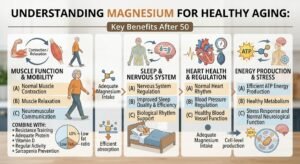
One of magnesium’s best-known roles is supporting healthy muscle function.
Magnesium helps regulate the balance between muscle contraction and muscle relaxation.
Without adequate magnesium, muscles may not function as efficiently.
Healthy magnesium levels support:
For adults over 50, preserving muscle function is essential for maintaining mobility and independence.
However, magnesium alone cannot prevent age-related muscle loss.
The strongest evidence supports combining:
Learn more in our related guides:
Strength Training After 50: The Best Routine for Healthy Aging
How Much Protein Do Adults Over 50 Really Need?
Sarcopenia: Symptoms, Causes, Prevention, and the Best Ways to Preserve Muscle After 50
Muscle cramps are commonly associated with magnesium, but the relationship is more complex than many people realize.
Muscle cramps can have multiple causes, including:
For individuals with magnesium deficiency, correcting that deficiency may help support normal muscle function.
However, current scientific evidence does not support magnesium supplementation as a universal treatment for muscle cramps in otherwise healthy adults.
Understanding the underlying cause of frequent cramps is more important than assuming magnesium deficiency is responsible.
Sleep quality often changes with age.
Many adults experience difficulty falling asleep or staying asleep, leading to increased interest in magnesium supplements.
Magnesium plays a role in nervous system regulation and helps support normal muscle relaxation.
It also participates in biological processes involved in maintaining healthy sleep patterns.
Some research suggests that magnesium supplementation may improve certain aspects of sleep in individuals with low magnesium status.
Potential benefits may include:
However, evidence remains mixed, and magnesium should not be considered a cure for insomnia.
Healthy sleep habits—including regular exercise, consistent sleep schedules, and good sleep hygiene—remain the foundation of restorative sleep.
The heart depends on magnesium to function properly.
Magnesium helps regulate electrical signals that coordinate each heartbeat.
Healthy magnesium levels contribute to:
Magnesium participates in the electrical activity that allows the heart to beat regularly.
Magnesium contributes to normal blood vessel function and may help support healthy blood pressure as part of an overall heart-healthy lifestyle.
Magnesium supports communication between muscles and nerves throughout the cardiovascular system.
Maintaining adequate magnesium intake through diet is associated with overall cardiovascular health.
However, magnesium supplements should not replace prescribed medical treatment for heart disease or high blood pressure.
Feeling constantly fatigued is a common concern among adults over 50.
Magnesium is involved in the production of adenosine triphosphate (ATP), the molecule that provides energy for nearly every cell in the body.
Without sufficient magnesium, cells cannot efficiently produce or utilize energy.
While fatigue has many possible causes—including poor sleep, anemia, thyroid disorders, chronic illness, and inadequate nutrition—maintaining healthy magnesium levels supports normal energy metabolism.
This is one reason magnesium is often included in discussions about healthy aging and physical performance.
Magnesium also plays a role in the body’s response to stress.
It contributes to normal nervous system function and helps regulate communication between brain cells and muscles.
Periods of prolonged stress may influence magnesium balance, while inadequate magnesium intake may affect normal neurological function.
Although magnesium is sometimes promoted as a natural stress remedy, current evidence suggests it should be viewed as one component of a comprehensive approach that includes healthy lifestyle habits, physical activity, adequate sleep, and stress management techniques.
Although calcium and vitamin D often receive most of the attention, magnesium is also essential for maintaining healthy bones.
Approximately 50–60% of the body’s magnesium is stored in bone tissue, where it contributes to bone structure and supports normal bone metabolism.
Magnesium also plays a role in the activation of vitamin D, helping the body use this important nutrient more effectively.
Healthy magnesium levels support:
Bone health depends on the interaction of multiple nutrients—not a single vitamin or mineral.
To learn more, read our complete guide:
Vitamin D for Healthy Aging: Benefits for Bones, Muscles, Immunity, and Longevity
A balanced diet remains the best way to obtain magnesium for most healthy adults.
Many plant-based foods naturally provide significant amounts of this mineral.
Excellent dietary sources include:
One of the richest natural sources of magnesium.
Almonds provide magnesium along with healthy fats, vitamin E, and fiber.
Dark leafy greens are excellent sources of magnesium and many other essential nutrients.
Legumes provide magnesium, plant protein, and dietary fiber, making them an excellent choice for healthy aging.
Avocados contribute magnesium while also providing heart-healthy monounsaturated fats.
Dark chocolate with a high cocoa content contains magnesium, although it should be consumed in moderation because of its calorie content.
Including a variety of whole foods helps improve overall nutrient intake and supports long-term health.
Not everyone needs a magnesium supplement.
For many adults, a varied diet that includes nuts, seeds, legumes, vegetables, and whole grains can provide sufficient magnesium.
However, supplementation may be appropriate for individuals who:
Before starting supplementation, it is advisable to discuss individual needs with a qualified healthcare provider.
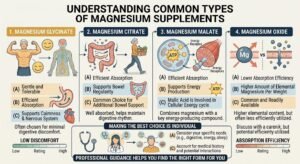
Magnesium supplements are available in several forms.
Each contains magnesium but differs in absorption, tolerability, and common uses.
Magnesium glycinate is well absorbed and is often chosen by individuals seeking a gentle form that is less likely to cause digestive discomfort.
Magnesium citrate is also well absorbed and is commonly used when additional support for bowel regularity is desired.
Magnesium malate combines magnesium with malic acid, a compound involved in cellular energy production.
Magnesium oxide contains a relatively high amount of elemental magnesium but is absorbed less efficiently than several other forms.
There is no single “best” magnesium supplement for everyone.
The most appropriate choice depends on individual health needs, medical history, and professional guidance.
Magnesium is frequently included in discussions about longevity because it supports many biological systems involved in healthy aging.
Research has linked adequate magnesium intake with healthy muscle function, cardiovascular health, bone maintenance, and normal metabolic processes.
However, current scientific evidence does not support magnesium supplementation as a way to directly increase lifespan.
Instead, maintaining adequate magnesium status helps support the body’s normal physiological functions, which contribute to healthy aging and long-term well-being.
Longevity is influenced by many interconnected lifestyle factors, including:
Magnesium is one valuable piece of this larger picture.
Magnesium supports muscle function, nerve signaling, bone health, heart function, energy production, and hundreds of enzymatic reactions that contribute to healthy aging.
Some studies suggest magnesium may improve sleep quality in individuals with low magnesium levels, but it should not be considered a treatment for chronic insomnia.
There is no universally best option. Magnesium glycinate, citrate, malate, and other forms may each be appropriate depending on an individual’s health needs and healthcare provider’s recommendations.
Magnesium may help individuals with magnesium deficiency, but muscle cramps have many possible causes. Current evidence does not support magnesium as a universal treatment for cramps.
Yes. Many adults can meet their magnesium needs through a balanced diet rich in vegetables, legumes, nuts, seeds, whole grains, and other minimally processed foods.
Magnesium is one of the body’s most important minerals, yet it is often overlooked in conversations about healthy aging.
Its role extends far beyond muscle function. Magnesium supports healthy bones, cardiovascular function, nerve signaling, energy production, and normal sleep physiology.
Although magnesium supplements are widely available, the foundation of healthy aging remains the same: a nutrient-rich diet, regular exercise, adequate sleep, stress management, and preventive healthcare.
For adults over 50, maintaining healthy magnesium levels is not about finding a miracle supplement—it is about supporting the body’s natural ability to stay strong, active, and resilient throughout the aging process.
Small daily habits, practiced consistently over time, remain the most powerful investment in long-term health.
• Barbagallo M, Dominguez LJ. Magnesium and Aging. Current Pharmaceutical Design. 2010.
Read the study → https://pubmed.ncbi.nlm.nih.gov/20388085/
• Veronese N, et al. Magnesium Status in Older Adults: A Systematic Review. Nutrients. 2021.
Read the study → https://pubmed.ncbi.nlm.nih.gov/34068465/
• Rosanoff A, Dai Q, Shapses SA. Essential Nutrient Interactions: Does Low or Suboptimal Magnesium Status Interact with Vitamin D and/or Calcium Status? Advances in Nutrition. 2016.
Read the study → https://pubmed.ncbi.nlm.nih.gov/26773013/
• National Institutes of Health. Magnesium Fact Sheet for Health Professionals.
Read the resource → https://ods.od.nih.gov/factsheets/Magnesium-HealthProfessional/

The Live Ever Better Editorial Team is dedicated to publishing evidence-based content that helps adults over 50 achieve healthier aging and greater longevity. Every article is carefully researched using scientific studies, clinical guidelines, and trusted health organizations to ensure accurate, practical, and reliable health information.