Physical Address
304 North Cardinal St.
Dorchester Center, MA 02124
Physical Address
304 North Cardinal St.
Dorchester Center, MA 02124

Constipation is one of the most common digestive concerns among adults over 60, affecting quality of life, comfort, and daily well-being. For many seniors looking for natural support, finding the best probiotics for adults over 60 with constipation may help improve bowel regularity and support a healthier gut environment when combined with proper nutrition and lifestyle habits.
As we grow older, several factors can influence digestive function, including reduced intestinal motility, changes in diet, lower physical activity levels, medication use, and natural changes in the gut microbiome.
The gut microbiome — the complex community of bacteria and other microorganisms living throughout the digestive tract — plays an important role in digestion, immune function, inflammation regulation, and intestinal health.
Emerging research suggests that certain probiotic strains may help support bowel regularity, improve stool consistency, and promote a healthier intestinal environment. However, probiotics are not interchangeable: the benefits depend largely on the specific bacterial strain, not simply the number of organisms listed on a supplement label.
For adults over 60 looking for natural constipation support, understanding which probiotic strains have scientific evidence can help make more informed decisions.
This guide explores the best probiotics for adults over 60 with constipation, including the strains most studied in clinical research, how they may work, and how to combine probiotics with lifestyle habits that support healthy aging.
• Some probiotic strains may help improve bowel regularity and constipation symptoms.
• Benefits depend on the specific bacterial strain rather than the total number of bacteria (CFUs).
• Probiotics work best alongside adequate fiber intake, hydration, and regular physical activity.
• Fermented foods remain an excellent natural source of beneficial bacteria that support gut health.
• Adults with chronic digestive symptoms should seek medical evaluation before self-treating.
Constipation is defined by symptoms such as infrequent bowel movements, hard stools, difficulty passing stool, or the sensation of incomplete evacuation.
Although constipation can affect adults at any age, it becomes more frequent later in life due to several physiological and lifestyle changes.
The digestive system undergoes gradual changes with aging.
Some factors that may contribute include:
The muscles and nerves responsible for moving food through the digestive tract may become less efficient over time, slowing intestinal transit.
Aging is associated with changes in microbial diversity and composition. Some beneficial bacteria may decrease, potentially affecting digestion, immune regulation, and bowel function.
Regular movement stimulates intestinal activity. Reduced mobility can contribute to slower bowel movements.
Several commonly used medications among older adults may contribute to constipation, including:
Older adults may consume less fiber due to reduced appetite, dental issues, dietary restrictions, or changes in food preferences.
The gut microbiome is increasingly recognized as a key factor in healthy aging.
A balanced microbiome helps regulate:
Beneficial bacteria, particularly species from the Bifidobacterium and Lactobacillus groups, have been studied for their potential role in maintaining intestinal balance.
However, probiotics should not be viewed as a universal solution. Different strains perform different functions, and a probiotic that helps one condition may not necessarily help another.
This is why choosing a probiotic based on scientific evidence is more important than choosing one based only on a high CFU number.
Choosing the best probiotics for adults over 60 with constipation requires understanding that probiotic benefits are strain-specific. Scientific studies suggest that certain Bifidobacterium and Lactobacillus strains may support bowel regularity, improve stool consistency, and promote a healthier intestinal environment.
Probiotics may influence digestive health through several mechanisms.
Some probiotic strains may increase the production of short-chain fatty acids, compounds produced by beneficial bacteria during fiber fermentation.
These compounds help support colon health and may influence normal intestinal movement.
Certain probiotics may increase stool moisture and improve stool texture, making bowel movements easier and more comfortable.
Probiotics may compete with less beneficial microorganisms and support a healthier microbial ecosystem.
A balanced microbiome may contribute to better digestive function.
The intestinal barrier plays an important role in controlling interactions between the gut and immune system.
Some probiotic strains have demonstrated potential benefits for maintaining intestinal barrier integrity.
Not every probiotic is equally effective.
Research suggests that specific strains — especially certain Bifidobacterium and Lactobacillus strains — have shown potential benefits for constipation and bowel regularity.
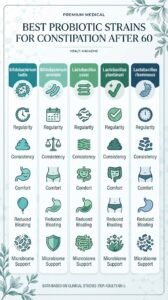
Bifidobacterium lactis is among the most studied probiotic strains for constipation.
Clinical research has investigated strains such as:
Potential benefits include:
For adults over 60, B. lactis is one of the probiotic strains with the strongest scientific support related to bowel regularity.
Lactobacillus casei has been studied for digestive comfort and intestinal balance.
Potential effects include:
Some fermented dairy products naturally contain Lactobacillus strains, making them part of traditional diets associated with digestive health.
Lactobacillus plantarum is recognized for its ability to survive passage through the digestive system.
Research suggests potential benefits including:
Although constipation-specific evidence is less extensive than B. lactis, it remains one of the most researched probiotic species for gastrointestinal health.
LGG is one of the most extensively studied probiotic strains worldwide.
Research has focused on its role in:
While evidence for constipation is not as strong as for some Bifidobacterium strains, LGG has a strong safety profile and broad scientific support.
Saccharomyces boulardii is a beneficial yeast rather than a bacterial probiotic.
It has been studied primarily for digestive conditions involving microbial imbalance.
Potential benefits include:
Its role specifically for constipation is less established, but it may be useful in certain digestive situations.
Multi-strain probiotics combine different species of beneficial microorganisms, often including several Bifidobacterium and Lactobacillus strains.
The potential advantage is that different strains may support different aspects of digestive health, including:
However, a higher number of strains does not automatically mean better results.
The most important factor remains whether the specific combination has been studied in humans.
For adults over 60, a clinically tested multi-strain formula may be a reasonable option, especially when constipation occurs alongside general digestive discomfort.
Prebiotics are types of dietary fibers that serve as food for beneficial bacteria.
Common prebiotics include:
When probiotics and prebiotics are combined, the combination is called a synbiotic.
Synbiotics may support digestive health by:
For older adults, combining probiotics with a fiber-rich diet may provide greater benefits than using probiotics alone.
Choosing a probiotic supplement requires looking beyond marketing claims.
A high-quality probiotic should identify the complete strain name.
For example:
Better:
Bifidobacterium animalis subsp. lactis BB-12
Less informative:
Bifidobacterium lactis
The strain matters because different strains of the same species may have different effects.
The strongest evidence comes from randomized controlled trials involving humans.
Look for probiotics that have been studied for:
CFU (colony-forming units) represents the number of viable microorganisms in a product.
However:
More CFUs do not necessarily mean better results.
A probiotic with fewer bacteria but a well-studied strain may be more effective than a product with a very high CFU count and limited evidence.
Look for:
Supplements are not the only way to consume beneficial microorganisms.
Fermented foods can provide naturally occurring probiotics and have been part of traditional diets for centuries.
Examples include:
A simple source of beneficial bacteria, especially when it contains clearly identified live cultures.
A fermented dairy drink containing multiple strains of bacteria and yeast.
Naturally fermented cabbage can provide beneficial microorganisms when it is unpasteurized.
A fermented vegetable food containing lactic acid bacteria.
Certain naturally fermented vegetables may contribute to microbiome diversity.
However, not every fermented food contains live probiotics. Processing methods such as pasteurization may eliminate beneficial bacteria.
Many fermented and fiber-rich foods fit naturally into the Mediterranean Diet for Healthy Aging.
Probiotics work best as part of a complete healthy aging strategy.

Many fiber-rich foods recommended here are also featured in our guide to Anti-Inflammatory Foods After 50.
Fiber provides structure and bulk for stool while also feeding beneficial gut bacteria.
Good sources include:
Increase fiber gradually to minimize bloating.
Many fiber-rich foods recommended here are also featured in our guide to Anti-Inflammatory Foods After 50.
Movement stimulates intestinal function.
Activities such as:
may support digestive regularity.
Daily walking supports both digestive function and overall longevity. Learn more in Walking and Longevity.
Fiber works best when combined with sufficient fluids.
Low fluid intake can make stools harder and more difficult to pass.
Protein becomes increasingly important after age 50 for preserving muscle mass, strength, and overall health.
A healthy digestive system also helps maximize nutrient absorption from a balanced diet. Read Protein After 50 for guidance on meeting protein needs as you age.
Although constipation is common, persistent symptoms should not always be managed with supplements alone.
Adults should seek medical evaluation if constipation is accompanied by:
These symptoms may require investigation for underlying medical conditions.
Bifidobacterium animalis subsp. lactis, particularly clinically studied strains such as BB-12 and HN019, has some of the strongest evidence for supporting bowel regularity.
Results vary between individuals. Many clinical studies evaluate probiotics after 4 to 8 weeks of daily use.
Consistency is important because probiotics typically need time to influence the gut environment.
Most healthy older adults tolerate probiotics well.
However, individuals with severe immune problems, serious illnesses, or complex medical conditions should speak with a healthcare professional before starting supplementation.
No.
Fiber remains one of the most important nutritional factors for healthy bowel function.
Probiotics may complement a fiber-rich diet but should not replace whole foods.
Both can support gut health.
Fermented foods provide a natural source of beneficial microorganisms and nutrients, while supplements offer specific strains that have been studied in clinical research.
Constipation after age 60 is influenced by many factors, including changes in gut microbiome composition, dietary patterns, medication use, physical activity levels, and hydration.
Among available options, the best probiotics for adults over 60 with constipation are generally those containing clinically studied strains such as Bifidobacterium lactis and certain Lactobacillus strains, especially when combined with healthy lifestyle habits.
The most effective approach is not simply choosing the probiotic with the highest CFU count. Instead, focus on clinically studied strains, a balanced diet rich in fiber, regular movement, adequate hydration, and attention to overall healthy aging.
To learn more about how the microbiome influences digestion, immunity, and healthy aging, read our complete guide to Gut Health After 50.
A well-supported gut is an important part of maintaining energy, resilience, and quality of life as we age.
• Dimidi E, et al. The effect of probiotics on functional constipation in adults: a systematic review and meta-analysis of randomized controlled trials. The American Journal of Clinical Nutrition.
Read the study → https://pubmed.ncbi.nlm.nih.gov/25099542/
• Miller LE, Ouwehand AC, Ibarra A. Effects of probiotic-containing products on stool frequency and intestinal transit in constipated adults: systematic review and meta-analysis of randomized controlled trials. Annals of Gastroenterology.
Read the study → https://pubmed.ncbi.nlm.nih.gov/29118557/
• Barros CP, et al. The effect of multistrain probiotics on functional constipation in the elderly: a randomized controlled trial. Beneficial Microbes.
Read the study → https://pubmed.ncbi.nlm.nih.gov/35927504/
• Li M, et al. Effects and Persistence of Bifidobacterium animalis subsp. lactis BL-99 and Fructooligosaccharides on Older Adults with Functional Constipation: A Randomized, Double-Blind, Placebo-Controlled Trial. Journal of Nutrition, Health & Aging.
Read the study → https://pubmed.ncbi.nlm.nih.gov/40499217/
The information provided in this article is for educational and informational purposes only and does not replace professional medical advice, diagnosis, or treatment. Always consult a qualified healthcare professional before starting any supplement, especially if you have a medical condition, take medications, or have specific health concerns.

The Live Ever Better Editorial Team is dedicated to publishing evidence-based content that helps adults over 50 achieve healthier aging and greater longevity. Every article is carefully researched using scientific studies, clinical guidelines, and trusted health organizations to ensure accurate, practical, and reliable health information.