Physical Address
304 North Cardinal St.
Dorchester Center, MA 02124
Physical Address
304 North Cardinal St.
Dorchester Center, MA 02124

Sleep is often overlooked as one of the most important pillars of healthy aging.
Many adults focus on eating better, exercising regularly, or taking supplements, yet underestimate how profoundly sleep influences nearly every system in the body. During sleep, the body repairs tissues, regulates hormones, consolidates memories, supports immune function, and prepares for the physical and mental demands of the following day.
After the age of 50, maintaining high-quality sleep becomes even more important. Natural changes in circadian rhythm, hormone production, and sleep architecture can make restful sleep more difficult to achieve. At the same time, inadequate sleep is increasingly associated with reduced cognitive performance, poorer cardiovascular health, impaired muscle recovery, and decreased overall well-being.
The growing body of research on sleep and healthy aging demonstrates that quality sleep is not simply a period of rest—it is an active biological process essential for maintaining long-term health, resilience, and independence.
Whether your goal is preserving memory, maintaining muscle mass, supporting heart health, or improving daily energy levels, better sleep deserves a central place in your healthy aging strategy.
The scientific evidence supporting sleep and healthy aging continues to grow, reinforcing that restorative sleep is one of the most important lifestyle habits for maintaining health, independence, and quality of life after 50.
Many people notice that sleep changes with age.
Falling asleep may take longer.
Nighttime awakenings become more frequent.
Early morning waking often becomes more common.
These changes are considered a normal part of aging to some extent, but poor sleep should never be accepted as inevitable.
Understanding the connection between sleep and healthy aging helps explain why healthcare professionals increasingly recommend prioritizing sleep alongside nutrition and physical activity.
Healthy sleep supports:
Because these systems become increasingly vulnerable with age, protecting sleep becomes one of the most valuable investments in long-term health.
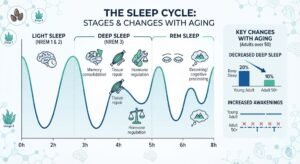
Sleep is organized into several stages that repeat throughout the night.
These include:
As adults grow older, several normal changes occur:
These changes do not necessarily mean that older adults require dramatically less sleep.
Instead, sleep often becomes lighter and less efficient.
Lifestyle habits, medical conditions, medications, stress, and reduced daytime physical activity may further contribute to poor sleep quality.
Fortunately, many of these factors are modifiable.
The brain remains remarkably active during sleep.
Rather than shutting down, it performs several essential functions that support cognitive health.
During sleep, the brain helps:
Researchers continue to investigate how sleep and healthy aging influence long-term cognitive health.
Although sleep alone cannot prevent neurological diseases, consistently obtaining adequate sleep is associated with better cognitive performance and overall brain function.
Combined with lifelong learning, regular exercise, social engagement, and balanced nutrition, quality sleep forms an essential pillar of brain health.
Research suggests that adults who regularly obtain sufficient, high-quality sleep generally perform better on tests of memory, attention, learning, and executive function than individuals with chronic sleep deprivation.
Heart health and sleep are closely connected.
During healthy sleep, blood pressure naturally declines, heart rate slows, and the cardiovascular system enters an important period of recovery.
Insufficient sleep has been associated with increased risks of several cardiovascular conditions, although many lifestyle factors contribute simultaneously.
Maintaining good sleep and healthy aging habits may help support:
These benefits reinforce why sleep is increasingly recognized as a fundamental component of preventive health.
Exercise stimulates the body to adapt.
Sleep is when much of that adaptation occurs.
Following resistance training or other physical activity, the body uses sleep to support:
For adults over 50, these recovery processes become particularly important because age-related muscle loss naturally accelerates over time.
The relationship between sleep and healthy aging also extends to maintaining strength, mobility, and independence.
When combined with adequate protein intake and regular strength training, healthy sleep supports one of the most effective strategies for preserving muscle throughout aging.
Related articles:
Adults who combine regular physical activity with consistent, high-quality sleep generally experience better recovery, improved physical performance, and healthier aging than those who neglect either habit.
One of the most common questions researchers continue to investigate is whether better sleep can actually increase lifespan.
The answer is not as simple as sleeping more.
Current evidence suggests that both sleep duration and sleep quality play important roles in long-term health. Numerous large observational studies have found that adults who consistently obtain approximately seven to nine hours of quality sleep generally experience lower risks of cardiovascular disease, metabolic disorders, cognitive decline, and premature mortality compared with individuals who regularly sleep too little or excessively.
However, scientists emphasize that sleep is only one component of healthy aging.
The relationship between sleep and healthy aging is strongest when quality sleep is combined with:
Rather than viewing sleep as a shortcut to longevity, it is more accurate to consider it one of the essential foundations of lifelong health.
Many adults assume they need less sleep as they grow older.
This is one of the most common misconceptions about aging.
Most healthy adults over 50 still benefit from approximately 7 to 9 hours of sleep per night, according to current expert recommendations.
Individual needs vary depending on factors such as:
The goal should not simply be sleeping longer, but sleeping well.
Understanding the relationship between sleep and healthy aging helps shift the focus from the number of hours slept to the overall quality and consistency of sleep.
High-quality sleep allows the body and brain to complete the restorative processes that are essential for sleep and healthy aging.
Improving sleep often begins with small, consistent habits rather than dramatic changes.
The following evidence-based strategies may help improve sleep quality over time.
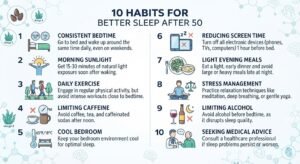
Going to bed and waking up at the same time every day helps regulate your internal body clock.
Natural light exposure shortly after waking supports healthy circadian rhythms and promotes better sleep at night.
Regular exercise is consistently associated with better sleep quality.
Walking, resistance training, and aerobic exercise all contribute to sleep and healthy aging when performed consistently.
Caffeine can remain in the body for several hours.
Avoiding coffee, energy drinks, and other caffeinated beverages during the afternoon or evening may improve sleep.
Aim for:
A restful environment supports deeper, more restorative sleep.
Blue light emitted by electronic devices may delay melatonin production.
Consider limiting screens during the hour before bedtime.
Large meals immediately before bedtime may interfere with sleep for some individuals.
If you are hungry, choose a light, balanced snack instead.
Relaxation techniques such as deep breathing, meditation, reading, or gentle stretching may help prepare the mind for sleep.
Although alcohol may initially promote drowsiness, it often disrupts sleep quality later in the night.
Chronic insomnia, loud snoring, excessive daytime sleepiness, or pauses in breathing during sleep should always be evaluated by a qualified healthcare professional.
Early diagnosis and treatment can significantly improve both sleep quality and overall health.
No.
Although sleep patterns naturally change with age, persistent poor sleep is not considered a normal part of aging and should not be ignored.
Most adults over 50 benefit from seven to nine hours of quality sleep each night, although individual needs vary.
Yes.
Regular physical activity is consistently associated with better sleep quality and is one of the most effective lifestyle habits supporting sleep and healthy aging.
Short naps may be beneficial for some individuals.
However, long or late-afternoon naps may interfere with nighttime sleep.
Melatonin may be appropriate for certain situations, but it should not replace healthy sleep habits.
Consult your healthcare provider before using any sleep supplement regularly.
Sleep and healthy aging are inseparable.
Quality sleep supports the brain, heart, immune system, muscles, metabolism, emotional well-being, and overall physical function.
While no single habit guarantees a longer life, consistently obtaining restorative sleep is one of the most effective lifestyle strategies for maintaining health and independence as we age.
Together with regular physical activity, strength training, balanced nutrition, and preventive healthcare, sleep and healthy aging form a powerful foundation for lifelong wellness.
Healthy aging does not happen overnight—but it depends on getting a good night’s sleep.
Making sleep and healthy aging a lifelong priority can improve daily well-being today while helping preserve physical and cognitive function for years to come.
• Watson NF, et al. Recommended Amount of Sleep for a Healthy Adult: A Joint Consensus Statement of the American Academy of Sleep Medicine and Sleep Research Society. Sleep.
Read the study → https://pubmed.ncbi.nlm.nih.gov/29073398/
• Medic G, Wille M, Hemels MEH. Short- and Long-Term Health Consequences of Sleep Disruption. Nature and Science of Sleep.
Read the study → https://pubmed.ncbi.nlm.nih.gov/24942566/
• National Institute on Aging. A Good Night’s Sleep.
Read the resource → https://www.nia.nih.gov/health/sleep
• Rasch B, Born J. About Sleep’s Role in Memory. Physiological Reviews.
Read the study → https://pubmed.ncbi.nlm.nih.gov/20926613/
This article is intended for educational purposes only and should not be considered medical advice, diagnosis, or treatment. The information provided is based on current scientific evidence available at the time of publication but may not apply to every individual. Always consult a qualified healthcare professional before making decisions about your health, starting a new exercise program, or using supplements or medications.

The Live Ever Better Editorial Team is dedicated to publishing evidence-based content that helps adults over 50 achieve healthier aging and greater longevity. Every article is carefully researched using scientific studies, clinical guidelines, and trusted health organizations to ensure accurate, practical, and reliable health information.