Physical Address
304 North Cardinal St.
Dorchester Center, MA 02124
Physical Address
304 North Cardinal St.
Dorchester Center, MA 02124

Many adults notice that remembering names becomes more difficult with age. Walking into a room and forgetting why you went there or struggling to recall someone’s name at a social event can feel frustrating. While occasional forgetfulness is a normal part of aging, it doesn’t necessarily mean that cognitive decline is inevitable.
These memory exercises for adults over 60 who forget names are simple to practice at home and can easily become part of a healthy daily routine.
Memory exercises for adults over 60 who forget names can help stimulate the brain, strengthen neural connections, and support cognitive performance as part of a healthy aging lifestyle. Research suggests that combining mental stimulation, physical activity, quality sleep, social engagement, and proper nutrition may help maintain memory and reduce the risk of cognitive decline.
The encouraging news is that your brain remains adaptable throughout life. This ability, known as neuroplasticity, allows new neural connections to form even later in adulthood.
In this guide, you’ll discover practical, evidence-based memory exercises and daily habits that can help keep your brain active and support long-term cognitive health.
Remembering names is one of the most complex memory tasks the brain performs.
Unlike faces, which are processed visually, names are abstract pieces of information with little natural association. As we age, slower processing speed and reduced attention can make retrieving names more challenging.
Understanding this process helps explain why memory exercises for adults over 60 who forget names focus on strengthening attention, association, and recall rather than simply repeating information.
Normal aging may involve:
However, forgetting names occasionally is very different from consistently forgetting familiar people, places, or important daily information.
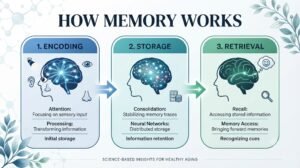
Understanding how memories are formed makes memory exercises for adults over 60 who forget names far more effective because each exercise targets a different stage of memory formation.
Memory develops through three essential stages:
Your brain first pays attention to new information.
Information is organized and stored within neural networks.
The brain accesses stored information when needed.
Many memory lapses occur because information was never fully encoded in the first place. Being distracted during introductions, for example, makes remembering names much more difficult.
Consistently practicing memory exercises for adults over 60 who forget names encourages the brain to strengthen existing neural pathways while forming new ones.
These exercises are only one part of maintaining lifelong cognitive function. Learn more in our complete guide to Brain Health After 50.
For many years, scientists believed the aging brain gradually lost its ability to change.
Today, research demonstrates that neuroplasticity continues throughout adulthood.
Learning new information encourages the brain to create and strengthen neural pathways.
This is one reason memory exercises for adults over 60 who forget names can remain effective even later in life.
One of the simplest memory techniques involves connecting a person’s name with something meaningful.
Examples include:
The stronger and more unusual the association, the easier the brain retrieves it later.
Repetition reinforces memory encoding.
Instead of hearing someone’s name only once, naturally repeat it several times during the conversation.
For example:
“Nice to meet you, Sarah.”
“So, Sarah, what do you enjoy doing?”
This simple habit significantly improves recall.
Turning words into mental images activates additional brain regions.
Imagine:
Visualization creates multiple retrieval pathways for the same memory.
Novel experiences are powerful brain stimulators.
Examples include:
Challenging the brain with unfamiliar tasks helps build cognitive reserve.
Reading activates multiple cognitive functions simultaneously:
Even reading for 20–30 minutes daily may help maintain cognitive function over time.
Many people strengthen memory by repeatedly reading information.
However, active recall is much more effective.
Instead of reviewing a list several times, try to remember it without looking.
For example:
This type of exercise strengthens retrieval pathways, which is exactly what memory exercises for adults over 60 who forget names are designed to improve.
Exercise benefits much more than muscles and the heart.
Regular physical activity increases blood flow to the brain and has been associated with better memory, executive function, and slower cognitive aging.
Excellent activities include:
Even 30 minutes of moderate activity most days of the week can provide meaningful cognitive benefits.
Brain games are most effective when they require genuine problem-solving rather than repetitive tasks.
Good options include:
Rotating different activities keeps the brain engaged by activating multiple cognitive domains.
Conversation is one of the brain’s most complex cognitive activities.
During social interaction, the brain simultaneously processes:
Regular social engagement has consistently been associated with healthier cognitive aging.
Volunteering, joining clubs, attending community events, or simply maintaining regular conversations with friends and family may help support long-term brain health.
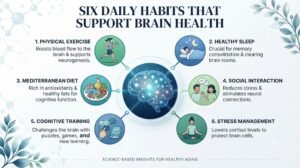
The greatest benefits occur when memory exercises for adults over 60 who forget names are combined with healthy lifestyle habits that support overall brain function.
Building healthy daily habits is one of the most effective ways to Improve Memory After 50 and support long-term cognitive performance.
Memory exercises for adults over 60 who forget names are most effective when combined with healthy lifestyle habits.
Memory consolidation occurs during sleep.
Poor sleep reduces attention, learning capacity, and recall the following day.
Aim for seven to nine hours of quality sleep whenever possible.
Quality sleep plays a vital role in memory consolidation. Learn more in Sleep and Healthy Aging.
Nutrition plays an important role in cognitive function.
Research consistently supports dietary patterns rich in:
The Mediterranean diet remains one of the most studied eating patterns for supporting healthy brain aging.
Chronic stress increases cortisol, a hormone that may interfere with memory formation when elevated for prolonged periods.
Helpful stress-management strategies include:
Untreated hearing loss has been associated with faster cognitive decline.
If conversations become increasingly difficult to follow, consider a professional hearing evaluation.
Supporting hearing health also supports brain health.
While occasional forgetfulness is common, understanding the early warning signs can help. Read our guide on Prevent Dementia to learn more about reducing long-term risk.
Occasional forgetfulness is common.
However, medical evaluation is recommended if memory problems begin interfering with daily life.
Examples include:
Early evaluation allows healthcare professionals to identify potentially reversible causes or diagnose cognitive disorders as early as possible.
Yes. Research suggests that mentally stimulating activities can strengthen cognitive reserve and support brain function. While no exercise guarantees prevention of dementia, regular cognitive challenges may help maintain memory and thinking skills.
Some of the most effective techniques include creating name associations, visualization, active recall, reading daily, learning new skills, solving puzzles, and maintaining regular social interaction.
Daily practice is ideal. Even 15–20 minutes of mentally stimulating activities each day may provide long-term cognitive benefits.
Yes. Aerobic exercise and strength training improve blood flow to the brain and have been associated with better memory and executive function.
No.
Occasional difficulty remembering names is a common part of normal aging. Persistent memory loss that interferes with daily life should be evaluated by a healthcare professional.
A Mediterranean-style eating pattern rich in vegetables, berries, fish, olive oil, legumes, whole grains, and nuts has the strongest scientific evidence for supporting long-term brain health.
Practicing memory exercises for adults over 60 who forget names is one of the most practical ways to stimulate lifelong learning and support healthy cognitive aging. Occasionally forgetting names is common, but keeping the brain active through consistent mental challenges may improve recall and strengthen cognitive reserve over time.
Practicing memory exercises for adults over 60 who forget names can help strengthen attention, improve recall, and support the brain’s remarkable ability to adapt through neuroplasticity.
Simple daily habits such as learning new skills, reading, exercising, staying socially active, eating a nutrient-rich diet, and getting enough sleep work together to support lifelong cognitive health.
The most effective approach is consistency. Small actions repeated every day can help keep your mind active, resilient, and engaged for years to come.
• Livingston G, et al. Dementia prevention, intervention, and care: 2024 report of the Lancet Standing Commission. The Lancet.
Read the study → https://pubmed.ncbi.nlm.nih.gov/38452713/
• Erickson KI, et al. Exercise training increases size of hippocampus and improves memory. Proceedings of the National Academy of Sciences.
Read the study → https://pubmed.ncbi.nlm.nih.gov/21282661/
• Ngandu T, et al. A 2-year multidomain intervention of diet, exercise, cognitive training, and vascular risk monitoring (FINGER Trial). The Lancet.
Read the study → https://pubmed.ncbi.nlm.nih.gov/25771249/
• World Health Organization. Risk reduction of cognitive decline and dementia: WHO Guidelines.
Read the guideline → https://www.who.int/publications/i/item/9789241550543
• National Institute on Aging. Cognitive Health and Older Adults.
Read the guide → https://www.nia.nih.gov/health/brain-health-and-cognitive-health
This article is intended for educational purposes only and should not be considered medical advice, diagnosis, or treatment. The information provided is based on current scientific evidence available at the time of publication but may not apply to every individual. Always consult a qualified healthcare professional before making decisions about your health, starting a new exercise program, or using supplements or medications.

The Live Ever Better Editorial Team is dedicated to publishing evidence-based content that helps adults over 50 achieve healthier aging and greater longevity. Every article is carefully researched using scientific studies, clinical guidelines, and trusted health organizations to ensure accurate, practical, and reliable health information.