Physical Address
304 North Cardinal St.
Dorchester Center, MA 02124
Physical Address
304 North Cardinal St.
Dorchester Center, MA 02124
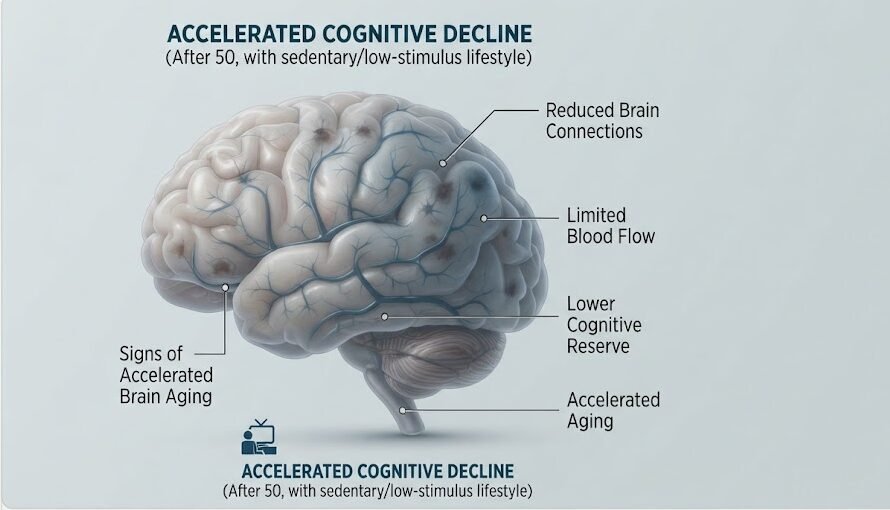
Aging is a natural process, but cognitive decline is not something that should simply be accepted as inevitable.
The human brain remains adaptable throughout life. Even after age 50, the brain continues to form new connections, respond to experiences, and adapt to new challenges through a process known as neuroplasticity.
However, maintaining optimal cognitive function requires intentional lifestyle choices.
As people get older, factors such as reduced physical activity, poor sleep, chronic stress, nutritional deficiencies, and metabolic changes can influence brain performance. This is why brain health after 50 has become one of the most important areas of research in healthy aging and longevity.
Protecting the brain is not about finding one magic solution. Instead, it involves combining several evidence-based habits that support circulation, reduce inflammation, maintain metabolic health, and stimulate the brain throughout life.
Building brain health after 50 requires consistency rather than perfection. Small daily habits practiced over many years can have a meaningful impact on cognitive resilience and overall healthy aging.
Exercise, quality sleep, nutritious food, social connections, and continuous learning all contribute to maintaining cognitive resilience as we age.
The brain changes throughout life.
Some changes are considered normal parts of aging, including:
These changes do not necessarily indicate disease.
Aging brains can remain highly functional, especially when supported by healthy lifestyle habits.
The brain contains billions of neurons connected through complex networks. These connections allow us to learn, remember experiences, solve problems, and interact with the world.
However, several biological processes may affect cognitive performance over time, including:
Understanding these changes is essential because many factors influencing brain health after 50 are modifiable.
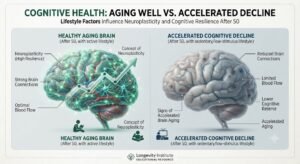
Brain health affects much more than memory.
Cognitive function influences almost every aspect of independent living, including:
Maintaining cognitive ability allows adults to continue pursuing meaningful goals, maintaining relationships, and enjoying an active lifestyle.
This is why protecting brain health after 50 is a central component of longevity.
Healthy aging is not only about living longer. It is about maintaining the ability to think clearly, stay independent, and participate fully in life.
For this reason, experts increasingly recognize brain health after 50 as one of the strongest predictors of long-term independence and quality of life.
Research increasingly suggests that lifestyle interventions may influence several pathways related to cognitive aging.
These include:
There is no single habit responsible for maintaining cognitive function.
The strongest scientific evidence suggests that brain health after 50 is best supported through multiple lifestyle habits working together rather than a single intervention.
Instead, the strongest evidence points toward a combination of daily behaviors that work together.
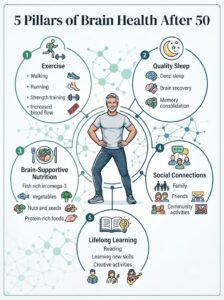
Physical activity is one of the most powerful tools for supporting the aging brain.
Exercise improves:
Aerobic activities such as walking, cycling, and running can increase levels of BDNF, a protein involved in maintaining and creating neural connections.
Resistance training is also important because preserving muscle strength is strongly connected with independence and overall healthy aging.
Combining strength training and aerobic exercise creates a powerful foundation for both physical and cognitive longevity.
Related article:
Strength Training After 50: The Best Routine for Healthy Aging
Sleep is one of the most important recovery processes for the brain.
During deep sleep, the brain performs essential functions including:
Poor sleep quality is associated with difficulties in attention, learning, and cognitive performance.
This is why sleep is a fundamental component of brain health after 50.
Adults who prioritize consistent, restorative sleep provide their brains with the recovery time needed to maintain optimal function.
Related article:
Sleep and Healthy Aging: Why Quality Sleep Matters More After 50
Nutrition plays a significant role in maintaining cognitive health.
The brain requires a constant supply of nutrients to support energy production, neurotransmitter function, and cellular protection.
Choosing nutrient-dense foods consistently is one of the most practical ways to support brain health after 50 while also promoting cardiovascular and metabolic health.
A brain-supportive eating pattern emphasizes:
Omega-3 fatty acids, especially EPA and DHA, have been extensively studied for their potential role in supporting brain structure and function.
Adequate protein intake also becomes increasingly important with age because maintaining muscle mass contributes to overall health and independence.
Related articles:
Omega-3 for Healthy Aging: Benefits for Heart, Brain, and Longevity
Protein After 50: How Much Protein Do Adults Need for Healthy Aging
Human beings are social creatures, and meaningful relationships play an important role in cognitive health.
Social interaction stimulates multiple areas of the brain involved in:
Research suggests that social isolation and loneliness are associated with poorer cognitive outcomes in older adults.
Maintaining relationships through family, friendships, community activities, volunteering, or group exercise can provide continuous mental stimulation.
For this reason, social connection should be considered an essential lifestyle strategy for brain health after 50.
A healthy brain is not only built through individual habits. It is also influenced by the quality of the environment and relationships surrounding us.
The brain benefits from continued stimulation.
Learning new skills, exploring unfamiliar topics, and engaging in mentally challenging activities may help maintain cognitive flexibility.
Examples include:
These activities encourage the formation of new neural pathways and support neuroplasticity.
The goal is not to complete a specific type of brain exercise, but to maintain curiosity and lifelong learning.
An active mind is an important part of a broader strategy for brain health after 50.
Among all lifestyle factors studied, exercise consistently appears as one of the strongest contributors to cognitive health.
Physical activity influences the brain through several mechanisms.
Exercise can:
Both aerobic exercise and resistance training have demonstrated benefits for cognitive function.
Aerobic activities such as walking, running, swimming, and cycling support cardiovascular fitness, which directly affects brain circulation.
Resistance training contributes by maintaining muscle mass, improving insulin sensitivity, and supporting overall physical resilience.
This connection between movement and cognition highlights why exercise is considered a cornerstone of brain health after 50.
Related article:
How Walking Improves Longevity: Benefits Beyond Cardio Fitness
Supplements should never replace healthy lifestyle habits, but some nutrients have been studied for their potential role in supporting cognitive function.
Although lifestyle remains the foundation, research continues to investigate how certain nutrients may complement strategies for improving brain health after 50.
The strongest foundation remains:
However, certain supplements may complement these habits.
Omega-3 fatty acids, particularly DHA, are important structural components of brain cell membranes.
Research has explored the relationship between omega-3 intake and:
Fatty fish such as salmon, sardines, and mackerel are excellent sources of EPA and DHA.
Related article:
Omega-3 for Healthy Aging: Benefits for Heart, Brain, and Longevity
Creatine is widely known for supporting muscle energy production, but emerging research has also explored its potential effects on brain energy metabolism.
The brain requires significant amounts of energy to maintain normal function.
Creatine supplementation may be especially relevant in situations where energy demands increase, including aging, physical stress, or periods of reduced dietary intake.
Related article:
Creatine for Healthy Aging: Benefits, Safety, and Muscle Support After 50
Vitamin D receptors are found throughout the body, including brain tissue.
Maintaining adequate vitamin D levels is important for overall health, immune function, and musculoskeletal strength.
Because vitamin D deficiency becomes more common with age, maintaining sufficient levels is an important consideration for healthy aging.
Related article:
Vitamin D for Healthy Aging: Benefits, Dosage, and Why It Matters After 50
Magnesium participates in hundreds of biological processes, including those related to nervous system function.
Adequate magnesium intake supports:
Because sleep and brain function are closely connected, magnesium may indirectly contribute to overall cognitive wellness.
Related article:
Magnesium Benefits After 50: Sleep, Muscle, and Healthy Aging
Cognitive decline is influenced by many factors, including genetics, health conditions, lifestyle, and environmental factors.
No lifestyle approach can guarantee complete prevention of age-related cognitive disorders.
However, scientific evidence suggests that many risk factors are modifiable.
According to major research initiatives on dementia prevention, important protective strategies include:
The concept of brain health after 50 is not about eliminating aging.
It is about maximizing cognitive resilience and supporting the brain’s ability to function well throughout life.
Protecting cognitive function is not about making occasional changes.
Establishing simple daily routines is one of the most sustainable ways to preserve brain health after 50 throughout the aging process.
The most powerful benefits come from consistent daily habits.
A brain-supportive lifestyle after 50 includes:
Regular movement supports circulation, metabolism, and neuroplasticity.
Adequate nutrition provides the building blocks required for maintaining brain and body function.
Consistent sleep routines support memory, emotional regulation, and recovery.
Chronic stress can negatively affect multiple systems, including brain health.
A curious mind remains adaptable and engaged.
Strong relationships provide emotional support and cognitive stimulation.
Together, these habits create a comprehensive approach to brain health after 50.
Improving memory involves supporting overall brain health through regular exercise, quality sleep, balanced nutrition, mental stimulation, and social engagement.
Some minor changes in memory and processing speed can occur with age. However, significant memory problems that interfere with daily life should always be evaluated by a healthcare professional.
Yes. Regular physical activity supports brain circulation, neuroplasticity, and metabolic health, making it one of the most effective lifestyle strategies for cognitive wellness.
Research suggests creatine may influence brain energy metabolism, although more studies are needed to fully understand its role in cognitive health.
A brain-supportive diet includes vegetables, fruits, fish, healthy fats, nuts, seeds, whole grains, and adequate protein.
Brain health after 50 is not determined by age alone.
The brain remains adaptable throughout life, and everyday choices can influence cognitive resilience, memory, and quality of life.
The strongest evidence points toward a combination of habits:
Healthy aging is not only about adding more years to life.
It is about protecting the ability to think clearly, remain independent, and continue enjoying meaningful experiences.
By investing in brain health today, adults over 50 can build a stronger foundation for a healthier and more active future.
Prioritizing brain health after 50 is an investment in independence, lifelong learning, and maintaining the cognitive abilities needed to enjoy every stage of healthy aging.
• Livingston G, et al. Dementia prevention, intervention, and care: 2020 report of the Lancet Commission. The Lancet.
Read the study → https://pubmed.ncbi.nlm.nih.gov/32738937/
• Erickson KI, et al. Exercise training increases size of hippocampus and improves memory. Proceedings of the National Academy of Sciences.
Read the study → https://pubmed.ncbi.nlm.nih.gov/21282661/
• Ngandu T, et al. A 2 year multidomain intervention of diet, exercise, cognitive training, and vascular risk monitoring. The Lancet.
Read the study → https://pubmed.ncbi.nlm.nih.gov/23390923/
• Voss MW, et al. The influence of aerobic fitness on cerebral white matter integrity and cognitive function in older adults. Human Brain Mapping.
Read the study → https://pubmed.ncbi.nlm.nih.gov/21780175/
This article is intended for educational purposes only and should not be considered medical advice, diagnosis, or treatment. The information provided is based on current scientific evidence available at the time of publication but may not apply to every individual. Always consult a qualified healthcare professional before making decisions about your health, starting a new exercise program, or using supplements or medications.

The Live Ever Better Editorial Team is dedicated to publishing evidence-based content that helps adults over 50 achieve healthier aging and greater longevity. Every article is carefully researched using scientific studies, clinical guidelines, and trusted health organizations to ensure accurate, practical, and reliable health information.