Physical Address
304 North Cardinal St.
Dorchester Center, MA 02124
Physical Address
304 North Cardinal St.
Dorchester Center, MA 02124
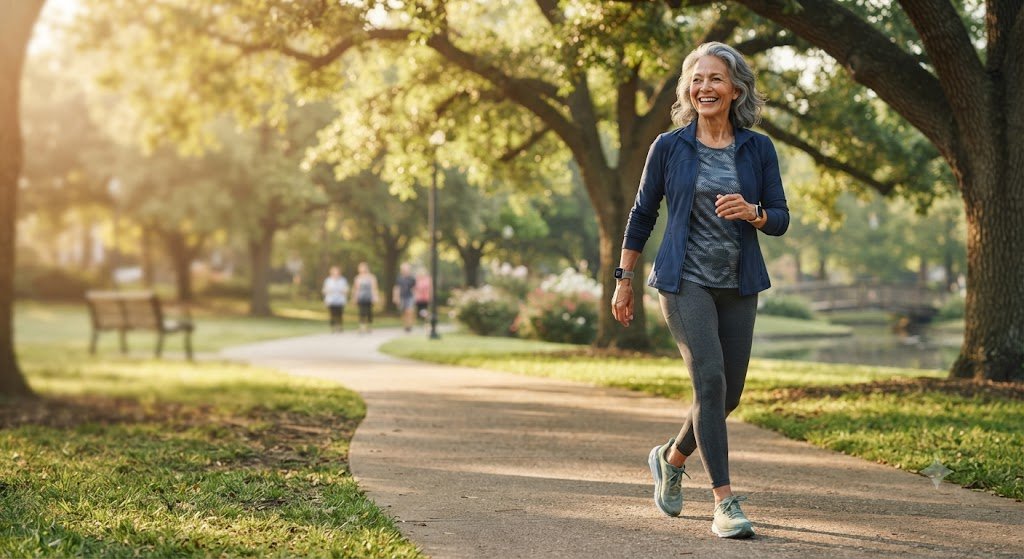
Blood sugar regulation becomes increasingly important after age 50, as changes in muscle mass, insulin sensitivity, physical activity levels, and metabolism can make it harder for the body to manage glucose efficiently.
For many adults looking for simple, sustainable strategies to support metabolic health, walking after breakfast to lower blood sugar after 50 is gaining attention as a practical habit supported by scientific research.
Unlike intense workouts that may require planning, equipment, or significant time commitments, a short walk after a meal is accessible, low-impact, and easy to incorporate into daily life.
Research suggests that moving the body after eating may help reduce post-meal glucose spikes by encouraging muscles to absorb circulating glucose. Since skeletal muscle is one of the largest tissues responsible for glucose disposal, even light movement can play an important role in healthy aging.
This habit is especially relevant after breakfast because morning glucose regulation can be influenced by hormonal changes, overnight fasting, and the body’s natural circadian rhythm.
While walking is not a replacement for medical treatment, medication, or a balanced diet, it can be a powerful lifestyle strategy when combined with proper nutrition, resistance training, and consistent daily movement.
This article explores how walking after breakfast to lower blood sugar after 50 may support glucose control, how long you should walk, the best pace for metabolic benefits, and how to build a sustainable walking routine for healthy aging.
A healthy morning routine begins with both nutrition and movement. Learn more about food choices that support glucose balance in our guide to Best Breakfast to Lower Morning Blood Sugar After 50.
• Walking after breakfast may help reduce post-meal blood sugar spikes by increasing glucose uptake by working muscles.
• Benefits come from muscle contractions and improved insulin sensitivity, not only from burning calories.
• Short walks of 10–30 minutes after eating may provide meaningful metabolic benefits.
• Consistency matters more than intensity when building a walking habit after age 50.
• Combining walking with strength training, adequate protein intake, and a Mediterranean-style diet provides broader healthy aging benefits.
Blood glucose regulation naturally changes with aging.
After age 50, several factors can influence how effectively the body processes carbohydrates and maintains stable blood sugar levels.
Insulin is a hormone that helps move glucose from the bloodstream into cells, where it can be used for energy.
Over time, many adults experience a gradual reduction in insulin sensitivity, meaning cells become less responsive to insulin’s signal.
This can contribute to:
Lifestyle habits such as regular exercise and muscle preservation are among the most important strategies for maintaining insulin sensitivity.
One of the most important connections between aging and blood sugar regulation is muscle health.
Skeletal muscle acts as a major storage site for glucose. When muscles contract during movement, they can absorb glucose from the bloodstream through pathways that do not depend entirely on insulin.
This means that walking, resistance training, and other forms of physical activity can directly support glucose management.
Maintaining muscle after 50 is therefore not only about strength and mobility — it is also about metabolic health.
Many people focus only on fasting glucose levels, but blood sugar responses after meals are also important.
After eating, carbohydrates are broken down into glucose, causing blood sugar levels to rise.
Large or prolonged glucose spikes may contribute to:
Small lifestyle adjustments, such as taking a walk after meals, may help the body handle glucose more efficiently.
Walking is often considered a simple cardiovascular activity, but its metabolic effects are more complex.
Each step requires muscle contraction, and muscle contraction creates signals that encourage glucose transport into muscle cells.
When you walk, especially after eating, your muscles require energy.
To meet this demand, muscle cells increase glucose uptake from the bloodstream.
This process can occur through activation of glucose transporter proteins, including GLUT4, which help move glucose into muscle cells.
The result:
Many people assume that only intense exercise improves blood sugar.
However, research suggests that low-intensity movement after meals may be particularly effective because it directly targets the period when glucose levels are rising.
A gentle walk after breakfast may:
The goal is not exhaustion — it is strategic movement at the right time.
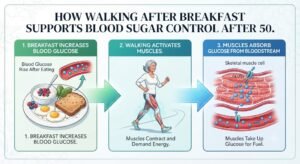
Research on post-meal walking suggests that timing physical activity close to meals may provide unique metabolic advantages.
Studies have found that walking shortly after eating can improve postprandial glucose responses compared with remaining inactive after meals.
For adults over 50, walking after breakfast to lower blood sugar after 50 may be especially valuable because it combines three important factors:
Unlike intense exercise programs, walking requires minimal recovery and can usually be repeated consistently.
Consistency is one of the strongest predictors of long-term health behavior success.
The primary mechanism behind post-meal walking is muscle activity.
When muscles contract, they signal the body to increase glucose transport into muscle cells.
This allows muscles to use circulating glucose for energy, helping reduce the amount remaining in the bloodstream.
Regular walking may improve how effectively cells respond to insulin.
Better insulin sensitivity means the body does not need to produce as much insulin to manage glucose levels.
Over time, consistent movement may support:
Morning routines can influence metabolic rhythms.
Breakfast occurs after an overnight fasting period, when the body transitions from using stored energy to processing incoming nutrients.
Adding movement after breakfast may help align energy intake with energy use.
This is one reason morning walking routines are often recommended as part of a healthy aging lifestyle.
Understanding how long to practice walking after breakfast to lower blood sugar after 50 can help adults create a realistic routine that fits their lifestyle.One of the biggest advantages of walking for metabolic health is that the required amount of time may be much shorter than many people expect.
You do not necessarily need a long workout to support better glucose control.
Research on post-meal movement suggests that even relatively short walks performed after eating may help improve blood sugar responses.
For many adults over 50, practical options include:
A short 10-minute walk can be an excellent starting point.
Benefits may include:
This approach is especially useful for people who have busy schedules or are beginning a new exercise routine.
A longer walk may provide additional benefits by increasing total daily movement and supporting cardiovascular health.
A 20–30 minute walk can combine:
The most effective duration is the one you can maintain consistently.
The ideal walking pace depends on your current fitness level, health status, and goals.
For blood sugar management, the objective is not necessarily maximum intensity.
A useful guideline:
You should be able to:
This type of movement is sustainable and appropriate for most adults over 50.
The goal of walking after breakfast to lower blood sugar after 50 is not maximum intensity, but consistent movement that supports glucose regulation over time.
A faster pace may provide additional cardiovascular benefits.
Signs of brisk walking:
For healthy adults, alternating between comfortable and brisk walking can create a progressive routine.
However, consistency remains more important than intensity when the primary goal is metabolic health.
Walking at different times can provide benefits, but post-breakfast walking has some unique advantages.
Among different daily movement strategies, walking after breakfast to lower blood sugar after 50 is particularly interesting because it targets the period when glucose levels naturally begin to rise after eating.
Potential benefits:
For many adults, this is the easiest walking habit to maintain.
A midday walk can also support glucose control, especially after larger meals.
Benefits include:
Evening walking has also been studied for metabolic benefits.
It may help:
The best time to walk is ultimately the time that allows you to be consistent.
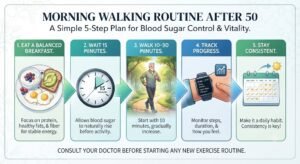
Creating a sustainable habit matters more than trying to make dramatic changes overnight.
A simple approach:
Begin with:
Then gradually increase duration or pace.
Creating a sustainable habit of walking after breakfast to lower blood sugar after 50 is easier when the activity is connected to an existing morning routine.
Attach walking to an existing habit.
Examples:
Habit stacking reduces the mental effort required to stay consistent.
Many adults enjoy using:
Tracking can provide motivation and help identify patterns.
Walking is powerful, but its benefits increase when combined with other pillars of healthy aging.
Walking supports glucose management, but resistance training is especially important after 50 because it helps preserve muscle mass.
More muscle provides a larger storage capacity for glucose and supports long-term metabolic health.
Learn more in our guide to Strength Training After 50.
Adequate protein supports muscle maintenance, recovery, and healthy aging.
A balanced diet with sufficient protein helps maximize the benefits of exercise.
Read Protein After 50 for guidance on meeting protein needs as you age.
The combination of:
supports cardiovascular and metabolic health.
Many of these foods are part of the Mediterranean Diet for Healthy Aging.
Chronic low-grade inflammation is associated with metabolic aging.
Foods rich in:
may support overall health.
Many foods that support blood sugar balance are also discussed in our guide to Anti-Inflammatory Foods After 50.
es. Research suggests that walking after breakfast to lower blood sugar after 50 may help reduce post-meal glucose spikes by increasing muscle glucose uptake and improving insulin sensitivity.
Many studies suggest that walking relatively soon after eating may be beneficial because it targets the period when blood glucose begins rising.
A practical approach is starting within 15–30 minutes after finishing breakfast.
A 10–30 minute walk can be a realistic and effective target for many adults over 50.
The best duration depends on fitness level, health conditions, and consistency.
Walking can support healthier blood sugar regulation and insulin sensitivity, which are important factors in metabolic health.
However, it does not guarantee diabetes prevention and should complement medical guidance, nutrition, and other healthy habits.
Walking is an excellent foundation for healthy aging, but adults over 50 should also include resistance training when possible to preserve muscle, strength, and metabolic function.
A simple walk after breakfast may be one of the most practical habits adults over 50 can adopt to support metabolic health.
The benefits of walking after breakfast to lower blood sugar after 50 come from a combination of muscle activation, improved glucose uptake, and better insulin sensitivity.
Unlike complicated exercise programs, walking is accessible, sustainable, and easy to integrate into everyday life.
For the greatest long-term impact, combine walking with strength training, adequate protein intake, a Mediterranean-style eating pattern, and other healthy aging strategies.
To better understand how daily movement influences longevity, explore our complete guide to Walking and Longevity.
Small actions repeated consistently can create meaningful improvements in health, independence, and quality of life as we age.
• DiPietro L, et al. Three 15-min bouts of moderate postmeal walking significantly improve 24-h glucose control in older people at risk for impaired glucose tolerance. Diabetes Care.
Read the study → https://pubmed.ncbi.nlm.nih.gov/23223345/
• Reynolds AN, Mann JI, Williams S, Venn BJ. Advice to walk after meals is more effective for lowering postprandial glycaemia than advice that does not specify timing: a randomized crossover study. Diabetologia.
Read the study → https://pubmed.ncbi.nlm.nih.gov/34030508/
• Colberg SR, et al. Exercise and Type 2 Diabetes: The American College of Sports Medicine and the American Diabetes Association joint position statement. Diabetes Care.
Read the study → https://pubmed.ncbi.nlm.nih.gov/21617109/
• DeFronzo RA, Tripathy D. Skeletal muscle insulin resistance is the primary defect in type 2 diabetes. Diabetes Care.
Read the study → https://pubmed.ncbi.nlm.nih.gov/18227460/
• Bird SR, Hawley JA. Update on the effects of physical activity on insulin sensitivity in humans. BMJ.
Read the study → https://pubmed.ncbi.nlm.nih.gov/21415176/
The information provided in this article is for educational and informational purposes only and does not replace professional medical advice, diagnosis, or treatment. Always consult a qualified healthcare professional before starting any supplement, exercise program, or lifestyle change, especially if you have a medical condition, take medications, or have specific health concerns.

The Live Ever Better Editorial Team is dedicated to publishing evidence-based content that helps adults over 50 achieve healthier aging and greater longevity. Every article is carefully researched using scientific studies, clinical guidelines, and trusted health organizations to ensure accurate, practical, and reliable health information.