Physical Address
304 North Cardinal St.
Dorchester Center, MA 02124
Physical Address
304 North Cardinal St.
Dorchester Center, MA 02124

Dementia is one of the greatest health concerns associated with aging. Many adults worry that occasional forgetfulness or slower thinking may be the first signs of a serious cognitive disorder.
While age is the strongest risk factor for dementia, growing older does not automatically mean developing it. In fact, a substantial body of scientific research suggests that many dementia risk factors are influenced by lifestyle, cardiovascular health, and everyday habits.
Learning how to prevent dementia begins with understanding what can—and cannot—be controlled. Although no strategy can completely eliminate the risk, evidence shows that healthy behaviors adopted throughout adulthood may help reduce the likelihood of cognitive decline and support long-term brain health.
This article explores what current science says about dementia prevention and presents practical, evidence-based habits that may help protect cognitive function as you age.
To better understand how lifestyle influences long-term cognitive resilience, read our complete guide to Brain Health After 50.
Dementia is not a single disease. Instead, it is a general term used to describe a group of conditions that progressively affect memory, thinking, language, reasoning, and the ability to perform everyday activities.
These changes occur because brain cells become damaged over time, disrupting communication between different areas of the brain.
Common symptoms may include:
Symptoms gradually worsen and eventually interfere with independent living.
Understanding dementia is an important first step for anyone interested in learning how to prevent dementia through healthy aging strategies.
Many people assume that any memory lapse is an early sign of dementia.
Fortunately, that is usually not the case.
Normal aging may include:
These minor changes generally do not interfere with daily life.
Dementia, however, affects much more than memory.
Individuals may become unable to manage finances, follow conversations, recognize familiar places, or perform routine activities they previously completed without difficulty.
Recognizing this distinction helps reduce unnecessary anxiety while encouraging early medical evaluation when appropriate.
If you’re experiencing normal age-related forgetfulness, our guide on Improve Memory After 50 explains practical strategies supported by scientific evidence.
Although the terms are often used interchangeably, dementia and Alzheimer’s disease are not the same.
Dementia refers to a syndrome—a collection of symptoms affecting cognitive function.
Alzheimer’s disease is the most common cause of dementia, accounting for approximately 60–70% of cases worldwide.
Other causes include:
Each condition has unique characteristics, but many share common lifestyle-related risk factors.
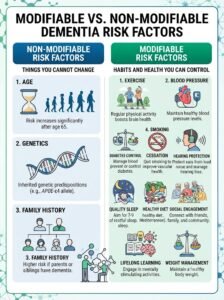
This is one of the most frequently asked questions in healthy aging.
The honest answer is:
Not completely—but the risk may be reduced.
According to the 2024 Lancet Commission on dementia prevention, treatment, and care, nearly half of dementia cases may be linked to potentially modifiable risk factors throughout life.
These include factors such as:
This does not mean these factors directly cause dementia in every individual.
Instead, they represent opportunities to support healthier brain aging and potentially reduce overall risk.
For anyone seeking to prevent dementia, focusing on these modifiable factors offers one of the most evidence-based approaches currently available.
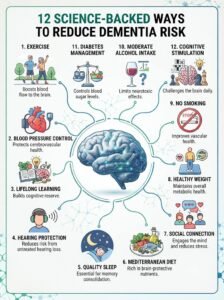
No single habit can completely protect the brain.
Instead, the strongest evidence supports combining multiple healthy behaviors that work together over many years.
Regular physical activity consistently ranks among the most effective lifestyle interventions for brain health.
Exercise supports:
Aerobic exercise and resistance training both contribute to healthier aging.
Experts generally recommend at least 150 minutes of moderate physical activity each week along with muscle-strengthening activities on two or more days.
Exercise remains one of the strongest lifestyle strategies to prevent dementia while improving overall quality of life.
Learn how resistance exercise supports both muscle and cognitive health in our complete guide to Strength Training After 50.
High blood pressure damages blood vessels throughout the body, including those supplying the brain.
Poor vascular health increases the risk of:
Maintaining healthy blood pressure through diet, exercise, weight management, and medical care is one of the most important long-term investments in brain health.
The brain benefits from continuous stimulation.
Learning new skills encourages neuroplasticity and helps build what researchers call cognitive reserve.
Activities include:
Mental stimulation should be viewed as lifelong exercise for the brain.
Keeping the brain challenged may help prevent dementia by strengthening neural networks throughout adulthood.
Hearing loss has emerged as one of the most significant modifiable risk factors for dementia.
Untreated hearing impairment may increase cognitive load, reduce social interaction, and contribute to faster cognitive decline.
Regular hearing evaluations and appropriate treatment—including hearing aids when indicated—may help support long-term brain health.
Sleep plays a critical role in memory consolidation and brain maintenance.
During deep sleep, the brain removes metabolic waste products through the glymphatic system.
Poor sleep has been associated with:
Adults should aim for approximately seven to nine hours of quality sleep each night.
Improving sleep habits is another practical strategy to prevent dementia while supporting overall health.
Better sleep is one of the most powerful ways to support brain health. Read our complete guide to Sleep and Healthy Aging.
One of the dietary patterns most consistently associated with healthy aging is the Mediterranean diet.
It emphasizes:
This eating pattern provides antioxidants, healthy fats, fiber, vitamins, and minerals that help protect both cardiovascular and brain health.
Diet alone cannot prevent dementia, but it forms an essential part of an evidence-based prevention strategy.
Strong social relationships contribute to emotional well-being and cognitive resilience.
Meaningful conversations, shared experiences, and community involvement stimulate multiple brain functions simultaneously, including memory, language, attention, and problem-solving.
Research has consistently linked social isolation and loneliness with an increased risk of cognitive decline and dementia.
Simple ways to stay socially connected include:
Maintaining an active social life is another important lifestyle habit that may help prevent dementia while improving overall quality of life.
Excess body weight, particularly during midlife, has been associated with several conditions that increase dementia risk.
Obesity often coexists with:
Together, these conditions may negatively affect brain health over time.
A balanced diet combined with regular physical activity supports both metabolic health and healthy brain aging.
Even regular walking contributes to healthier aging. Discover the benefits in Walking and Longevity.
Smoking damages blood vessels, increases oxidative stress, and promotes chronic inflammation throughout the body.
These harmful effects extend to the brain and may contribute to accelerated cognitive aging.
The good news is that quitting smoking provides health benefits at any age.
Stopping tobacco use supports cardiovascular health, lung function, and may reduce several modifiable risk factors associated with dementia.
Heavy alcohol consumption has been linked to structural and functional changes in the brain.
Excessive alcohol intake may impair:
Current evidence suggests that limiting alcohol consumption is a sensible component of a comprehensive strategy to prevent dementia and maintain long-term cognitive health.
The brain requires a stable supply of glucose to function efficiently.
However, persistently elevated blood sugar levels can damage blood vessels and increase inflammation.
Managing diabetes through:
helps protect multiple organs, including the brain.
Good metabolic health is closely linked to healthy cognitive aging.
Education does not end after school.
The brain benefits from lifelong curiosity and continuous learning.
Activities that challenge the brain include:
These experiences stimulate new neural pathways and strengthen cognitive reserve.
Remaining intellectually engaged throughout life is one of the healthiest long-term habits for anyone seeking to prevent dementia.
Although occasional forgetfulness is common with aging, certain symptoms deserve medical evaluation.
Consult a healthcare professional if you or a loved one experiences:
Early assessment does not always lead to a dementia diagnosis.
Many treatable medical conditions—including vitamin deficiencies, thyroid disorders, sleep apnea, depression, medication side effects, and hearing loss—can also affect memory and cognitive performance.
There is currently no guaranteed way to completely prevent dementia. However, research suggests that addressing modifiable risk factors may significantly reduce the likelihood of developing the condition.
Age remains the strongest risk factor. However, cardiovascular health, physical activity, sleep, smoking, diabetes, hearing loss, and education also influence long-term risk.
Regular exercise is consistently associated with better brain health and lower rates of cognitive decline. It supports blood flow, neuroplasticity, cardiovascular health, and metabolic function.
No. Dementia is a general syndrome involving cognitive decline, while Alzheimer’s disease is the most common cause of dementia.
Healthy dietary patterns such as the Mediterranean diet are associated with better cardiovascular and brain health and may contribute to reducing dementia risk as part of an overall healthy lifestyle.
Learning how to prevent dementia begins with understanding that healthy brain aging is influenced by many factors throughout life.
Although no lifestyle habit can guarantee complete protection, current scientific evidence shows that many risk factors are modifiable.
Regular exercise, healthy nutrition, quality sleep, cardiovascular health, lifelong learning, social engagement, and avoiding smoking all work together to support cognitive resilience.
The goal is not simply to live longer—it is to preserve memory, independence, and quality of life for as many years as possible.
By adopting these evidence-based habits today, you can take meaningful steps toward healthier brain aging and potentially prevent dementia by reducing your overall risk.
• Livingston G, et al. Dementia prevention, intervention, and care: 2024 report of the Lancet Standing Commission. The Lancet.
Read the study → https://pubmed.ncbi.nlm.nih.gov/38452713/
• World Health Organization. Risk reduction of cognitive decline and dementia: WHO Guidelines.
Read the guideline → https://www.who.int/publications/i/item/9789241550543
• Erickson KI, et al. Exercise training increases size of hippocampus and improves memory. Proceedings of the National Academy of Sciences.
Read the study → https://pubmed.ncbi.nlm.nih.gov/21282661/
• Ngandu T, et al. A 2-year multidomain intervention of diet, exercise, cognitive training, and vascular risk monitoring (FINGER Trial). The Lancet.
Read the study → https://pubmed.ncbi.nlm.nih.gov/25771249/
This article is intended for educational purposes only and should not be considered medical advice, diagnosis, or treatment. The information provided is based on current scientific evidence available at the time of publication but may not apply to every individual. Always consult a qualified healthcare professional before making decisions about your health, starting a new exercise program, or using supplements or medications.

The Live Ever Better Editorial Team is dedicated to publishing evidence-based content that helps adults over 50 achieve healthier aging and greater longevity. Every article is carefully researched using scientific studies, clinical guidelines, and trusted health organizations to ensure accurate, practical, and reliable health information.