Physical Address
304 North Cardinal St.
Dorchester Center, MA 02124
Physical Address
304 North Cardinal St.
Dorchester Center, MA 02124

High triglycerides are one of the most common metabolic abnormalities affecting adults over 50, yet many people don’t fully understand what they are or why they matter. Unlike cholesterol, triglycerides receive less public attention, even though elevated levels are strongly associated with cardiovascular disease, metabolic syndrome, insulin resistance, and fatty liver disease.
Triglycerides are a type of fat (lipid) found in the bloodstream. After you eat, your body converts calories it doesn’t immediately use into triglycerides, which are stored in fat cells and released later for energy. While this is a normal physiological process, chronically elevated triglyceride levels can signal underlying metabolic dysfunction.
The good news is that high triglycerides after 50 often respond remarkably well to lifestyle changes. Improving nutrition, increasing physical activity, reducing visceral fat, limiting added sugars, and enhancing insulin sensitivity can significantly lower triglyceride levels and reduce long-term cardiovascular risk.
In this evidence-based guide, you’ll learn what causes high triglycerides after 50, why they increase disease risk, how they differ from cholesterol, and the science-backed strategies that naturally improve triglyceride levels and support healthy aging.
Understanding high triglycerides after 50 begins with understanding what triglycerides actually are.
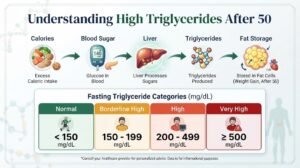
Triglycerides are the body’s primary storage form of fat. They circulate through the bloodstream and provide energy between meals. However, when more calories are consumed than the body requires—especially from refined carbohydrates, sugar, and alcohol—triglyceride production increases substantially.
According to current clinical guidelines, fasting triglyceride levels are generally classified as:
Persistently elevated triglycerides often indicate metabolic imbalance rather than simply excessive fat intake.
Several physiological changes make high triglycerides after 50 increasingly common.
As insulin sensitivity declines with age, the liver produces more triglycerides while simultaneously becoming less efficient at clearing them from circulation.
Abdominal fat is metabolically active.
It releases inflammatory compounds and free fatty acids directly into the liver, stimulating additional triglyceride production.
For more information, read How to Lose Visceral Fat After 50 Naturally.
Muscles become less effective at using circulating fat for energy when daily movement decreases.
This contributes to higher triglyceride concentrations.
Frequent consumption of:
has a much greater effect on triglycerides than dietary cholesterol itself.
Declining estrogen in women and gradual testosterone reduction in men alter body composition and lipid metabolism, increasing the likelihood of elevated triglycerides.
Many people confuse triglycerides with cholesterol, but they perform different functions.
Cholesterol is used to build cells, hormones, and vitamin D.
Triglycerides primarily store unused energy.
Both are measured during a lipid profile, but elevated triglycerides often reflect excess calorie intake, insulin resistance, and metabolic dysfunction.
While LDL cholesterol is strongly associated with plaque formation, high triglycerides frequently accompany:
Together, these abnormalities significantly increase cardiovascular risk.
The most common causes include:
Large amounts of added sugar rapidly increase liver triglyceride production.
White bread, pastries, sweets, and sugary cereals produce rapid blood glucose spikes that stimulate triglyceride synthesis.
Alcohol is one of the strongest dietary contributors to elevated triglycerides because it is preferentially metabolized by the liver.
Particularly abdominal obesity.
Sedentary behavior reduces fat oxidation and contributes to worsening lipid metabolism.
Elevated blood glucose and insulin resistance directly increase triglyceride production.
Learn more in How to Reverse Prediabetes After 50 Naturally.
High triglycerides are one of the defining components of metabolic syndrome.
Read Metabolic Syndrome After 50: Signs, Causes and How to Reverse It Naturally.
Although triglycerides often receive less attention than cholesterol, elevated levels can significantly increase the risk of several chronic diseases.
High triglycerides frequently indicate that the body’s metabolism is under stress, particularly when combined with insulin resistance, abdominal obesity, and chronic inflammation.
People with high triglycerides after 50 are more likely to develop:
While triglycerides themselves are only part of the overall cardiovascular picture, elevated levels usually occur alongside other important risk factors, including low HDL cholesterol and insulin resistance.
Learn more in How to Prevent Heart Disease After 50.
High triglycerides represent one of the five diagnostic criteria for metabolic syndrome.
When elevated triglycerides occur together with increased waist circumference, high blood pressure, elevated blood sugar, and low HDL cholesterol, overall cardiovascular risk rises substantially.
Read Metabolic Syndrome After 50: Signs, Causes and How to Reverse It Naturally.
Excess triglycerides often accumulate inside liver cells.
Over time, this may contribute to:
Reducing triglycerides is one of the most effective ways to improve liver health.
Very high triglyceride levels—particularly above 500 mg/dL—can dramatically increase the risk of acute pancreatitis.
This is considered a medical condition requiring prompt evaluation and treatment.
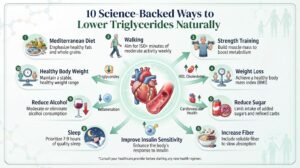
Fortunately, high triglycerides after 50 often improve significantly with healthy lifestyle changes.
Research consistently demonstrates that combining nutrition, exercise, and weight management produces greater improvements than any single intervention alone.
Sugar has a particularly strong effect on triglyceride production.
The liver converts excess sugar into triglycerides through a process called de novo lipogenesis.
Limiting:
can produce noticeable improvements in blood lipid levels.
Replacing refined carbohydrates with higher-fiber options helps stabilize blood glucose while reducing triglyceride production.
Better choices include:
These foods also improve satiety and support healthier body weight.
The Mediterranean diet remains one of the most effective eating patterns for lowering triglycerides.
Its emphasis on:
helps reduce inflammation while improving the entire lipid profile.
Read Mediterranean Diet for Healthy Aging.
Even modest reductions in abdominal fat frequently produce large improvements in triglyceride levels.
Losing only 5–10% of body weight has been shown to improve:
For practical strategies, read How to Lose Visceral Fat After 50 Naturally.
Walking improves the body’s ability to burn fat for energy.
Regular brisk walking:
Most adults benefit from at least 150 minutes of moderate-intensity exercise per week.
Read Walking and Longevity.
Building muscle increases metabolic efficiency and improves how the body processes glucose and fat.
Strength training contributes to lower triglycerides by:
Learn more in Strength Training After 50.
High triglycerides and insulin resistance almost always occur together.
Improving insulin sensitivity naturally lowers triglyceride production while improving overall metabolic health.
Read How to Improve Insulin Sensitivity After 50 Naturally.
Poor sleep contributes to:
Adults obtaining seven to nine hours of quality sleep generally demonstrate healthier lipid profiles.
Read Sleep and Healthy Aging and How to Sleep Better After 50 Naturally.
Alcohol significantly increases triglyceride production in many individuals.
People with elevated triglycerides often experience measurable improvements simply by reducing or eliminating alcoholic beverages.
Lowering triglycerides is rarely about one dramatic change.
Instead, long-term success comes from consistently practicing healthy behaviors such as:
Read Daily Habits to Stay Healthy After 50.
Yes.
For many adults, high triglycerides after 50 respond rapidly to lifestyle improvements.
Some individuals see meaningful reductions within four to twelve weeks, especially after improving diet, increasing exercise, and losing visceral fat.
The greatest improvements usually occur when multiple healthy habits are combined rather than relying on a single intervention.
Triglyceride levels are generally classified as:
Very high triglyceride levels significantly increase the risk of acute pancreatitis and require prompt medical evaluation.
Yes.
Many adults successfully lower high triglycerides after 50 through healthy lifestyle changes such as improving their diet, losing excess body weight, increasing physical activity, reducing alcohol intake, and improving insulin sensitivity.
For some individuals, medication may also be necessary, but lifestyle modification remains the foundation of treatment.
Both are important.
LDL cholesterol remains one of the strongest predictors of atherosclerosis, while elevated triglycerides often indicate underlying metabolic dysfunction.
Together, LDL cholesterol, HDL cholesterol, triglycerides, blood pressure, blood sugar, and waist circumference provide a much more complete picture of cardiovascular health.
Foods associated with healthier triglyceride levels include:
Replacing refined carbohydrates and added sugars with these nutrient-dense foods is one of the most effective dietary strategies.
Absolutely.
Regular brisk walking increases fat utilization, improves insulin sensitivity, supports weight loss, and contributes to lower triglyceride levels.
Combined with strength training and healthy nutrition, walking is one of the most sustainable lifestyle interventions for adults over 50.
Learning you have high triglycerides after 50 should not be viewed as a reason for panic—it should be viewed as an opportunity to improve your metabolic health before more serious problems develop.
Elevated triglycerides rarely occur in isolation. They often reflect insulin resistance, excess visceral fat, chronic inflammation, poor dietary habits, or physical inactivity. Addressing these root causes not only lowers triglycerides but also reduces the risk of heart disease, stroke, fatty liver disease, metabolic syndrome, and type 2 diabetes.
The encouraging news is that high triglycerides after 50 are highly responsive to lifestyle changes. Following a Mediterranean-style diet, reducing added sugars, maintaining a healthy weight, walking regularly, building muscle, sleeping well, and limiting alcohol can produce significant improvements within just a few months.
Rather than focusing on one laboratory value, think of triglycerides as an important marker of your overall metabolic health. Every healthy habit you adopt supports your heart, improves longevity, and helps you enjoy a healthier, more active future.
• American Heart Association. Triglycerides.
Read the resource → https://www.heart.org/en/health-topics/cholesterol/about-cholesterol/triglycerides
• National Heart, Lung, and Blood Institute. High Blood Triglycerides.
Read the guide → https://www.nhlbi.nih.gov/health/high-blood-triglycerides
• Centers for Disease Control and Prevention. About Cholesterol.
Read the publication → https://www.cdc.gov/cholesterol/
• Miller M, et al. Triglycerides and Cardiovascular Disease: A Scientific Statement From the American Heart Association. Circulation.
Read the study → https://pubmed.ncbi.nlm.nih.gov/19470878/
• Nordestgaard BG, et al. Fasting Is Not Routinely Required for Determination of a Lipid Profile. European Heart Journal.
Read the publication → https://pubmed.ncbi.nlm.nih.gov/27122601/
• World Health Organization. Cardiovascular Diseases (CVDs).
Read the resource → https://www.who.int/news-room/fact-sheets/detail/cardiovascular-diseases-(cvds)
The information provided in this article is for educational purposes only and should not be considered medical advice. Always consult a qualified healthcare professional before making changes to your diet, exercise routine, medications, or supplement use. Never disregard professional medical advice or delay seeking it because of something you have read on this website.

The Live Ever Better Editorial Team is dedicated to publishing evidence-based content that helps adults over 50 achieve healthier aging and greater longevity. Every article is carefully researched using scientific studies, clinical guidelines, and trusted health organizations to ensure accurate, practical, and reliable health information.