Physical Address
304 North Cardinal St.
Dorchester Center, MA 02124
Physical Address
304 North Cardinal St.
Dorchester Center, MA 02124

Developing the right daily habits to stay healthy after 50 may be one of the most important investments you can make for your future. While genetics certainly influence how we age, research consistently shows that everyday lifestyle choices have a much greater impact on healthspan—the number of years you live in good health—than many people realize.
The encouraging news is that you don’t need to make dramatic changes overnight. The most effective daily habits to stay healthy after 50 are often simple, sustainable actions that become part of your routine. Small improvements repeated consistently can lower the risk of heart disease, diabetes, dementia, osteoporosis, and many other chronic conditions associated with aging.
Whether your goal is to stay active, maintain your independence, improve your energy levels, or simply enjoy more healthy years with your family, adopting the right daily habits creates a strong foundation for lifelong wellness.
In this guide, you’ll discover the daily habits to stay healthy after 50 that are supported by scientific evidence and can help you age with greater strength, vitality, and confidence.
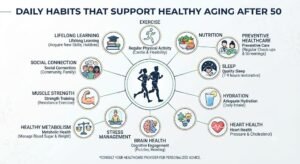
Many people believe aging is primarily determined by genetics.
While genes certainly play a role, studies suggest that lifestyle factors account for a much larger portion of healthy aging than inherited traits alone.
Healthy daily routines influence:
Learning the right daily habits to stay healthy after 50 allows you to positively influence many of these factors every single day.
In fact, many scientists now focus on healthspan rather than lifespan, emphasizing the importance of living healthier—not simply living longer.
If you’d like to understand how lifestyle influences biological aging, read our comprehensive guide to How to Reduce Your Biological Age Naturally.
Physical activity remains one of the strongest predictors of healthy aging.
Daily movement improves:
You don’t have to spend hours in the gym.
Even:
can significantly improve long-term health.
One of the simplest daily habits to stay healthy after 50 is making movement part of your everyday routine instead of treating exercise as an occasional event.
Walking is one of the easiest places to start. Learn more in Walking and Longevity.
After age 50, adults naturally begin losing muscle mass—a condition known as sarcopenia.
Maintaining muscle helps:
Strength training two to three times each week is one of the most effective daily habits to stay healthy after 50, even though the workouts themselves aren’t daily.
Daily protein intake and regular movement help preserve the results between sessions.
Learn more:
Healthy eating doesn’t require perfection.
Instead, aim for meals built around:
This dietary pattern reduces inflammation while supporting heart, brain, and metabolic health.
One of the easiest daily habits to stay healthy after 50 is filling most of your plate with minimally processed foods.
The Mediterranean diet remains one of the most researched eating patterns for healthy aging. Learn more in Mediterranean Diet for Healthy Aging.
Sleep is when your body repairs tissues, consolidates memories, regulates hormones, and supports immune function.
Poor sleep has been associated with:
Aim for 7–9 hours of quality sleep each night whenever possible.
Making sleep a priority is one of the smartest daily habits to stay healthy after 50, as it affects nearly every aspect of physical and mental health.
Our guide to Sleep and Healthy Aging offers practical strategies to improve sleep quality naturally.
Just as muscles need regular exercise, your brain benefits from continuous stimulation.
Healthy cognitive habits include:
Mental stimulation helps build cognitive reserve, which may reduce the impact of age-related cognitive decline.
Among the most valuable daily habits to stay healthy after 50 is dedicating time each day to activities that challenge your mind.
Continue learning in Brain Health After 50 and Improve Memory After 50.
Hydration is often overlooked, yet it supports nearly every function in the body.
As we age, our sense of thirst naturally declines, increasing the risk of chronic dehydration.
Even mild dehydration can contribute to:
Drinking water consistently is one of the simplest daily habits to stay healthy after 50 because it supports circulation, kidney function, digestion, and temperature regulation.
While individual needs vary depending on activity level and climate, making water your primary beverage is a smart long-term strategy.
Heart disease remains the leading cause of death among adults over 50.
Fortunately, many cardiovascular risk factors respond well to healthy lifestyle habits.
Protect your heart by:
Adding these behaviors to your routine makes daily habits to stay healthy after 50 even more effective because cardiovascular health influences every organ in the body.
Learn more in How to Lower Blood Pressure Naturally After 50.
Stable blood sugar supports:
Healthy glucose regulation depends on a combination of:
Among the most valuable daily habits to stay healthy after 50 is choosing meals that keep blood sugar stable instead of causing repeated spikes throughout the day.
Discover practical strategies in How to Improve Insulin Sensitivity After 50 Naturally.
Chronic stress doesn’t simply affect your mood.
Persistently elevated stress hormones can contribute to:
Healthy stress management doesn’t require eliminating stress completely.
Instead, develop routines such as:
One of the most sustainable daily habits to stay healthy after 50 is intentionally creating moments of recovery every day.
Healthy aging isn’t only physical.
Strong social relationships have consistently been linked to:
Simple ways to stay connected include:
Social interaction is one of the most underestimated daily habits to stay healthy after 50, yet research suggests it plays a major role in longevity.
Your brain thrives on novelty.
Learning stimulates the formation of new neural connections and supports lifelong cognitive resilience.
Consider:
Curiosity itself is one of the healthiest daily habits to stay healthy after 50, helping maintain mental flexibility and cognitive reserve.
Preventive care helps identify health issues before symptoms appear.
Regular screenings may include:
Preventive medicine complements all the daily habits to stay healthy after 50, allowing early intervention when needed.
Healthy aging isn’t about avoiding doctors—it’s about partnering with healthcare professionals to stay healthy longer.
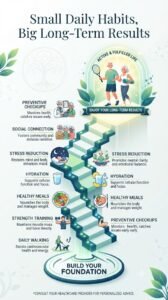
Many people underestimate the power of consistency.
Improving your health doesn’t require changing everything at once.
Instead, start by adopting one or two daily habits to stay healthy after 50, then gradually build upon them.
For example:
Week 1
Week 2
Week 3
Week 4
Small habits become automatic over time, creating lasting improvements in healthspan without feeling overwhelming.
Even well-intentioned adults sometimes focus on habits that are difficult to sustain.
Common mistakes include:
The most effective daily habits to stay healthy after 50 are realistic enough to continue for years—not just weeks.
The most effective habits include regular physical activity, strength training, healthy eating, quality sleep, stress management, staying socially connected, maintaining a healthy weight, and keeping your brain active.
Absolutely not.
Research consistently shows that adults who adopt healthier lifestyles later in life still experience meaningful improvements in longevity, physical function, and quality of life.
Some benefits—such as improved energy, better sleep, and lower blood sugar—may appear within weeks. Other benefits, including reduced cardiovascular risk and healthier aging, develop gradually over months and years.
There isn’t a single “best” habit.
However, combining regular exercise, healthy nutrition, quality sleep, and avoiding smoking produces some of the greatest improvements in overall health and longevity.
Adopting the right daily habits to stay healthy after 50 isn’t about chasing perfection—it’s about making consistent choices that support your body and mind every day. While no single habit can guarantee a longer life, the combined effect of healthy nutrition, regular movement, restorative sleep, stress management, preventive healthcare, and meaningful social connections can dramatically improve your healthspan.
The encouraging reality is that it’s never too late to begin. Every healthy meal, every walk around the neighborhood, every strength-training session, and every good night’s sleep is an investment in your future. Over time, these seemingly small decisions compound into significant improvements in energy, mobility, cardiovascular health, brain function, and overall quality of life.
Remember that the best daily habits to stay healthy after 50 are the ones you can maintain consistently. Start with one or two realistic changes, allow them to become part of your routine, and gradually build a healthier lifestyle that supports aging with strength, independence, and vitality.
Healthy aging isn’t achieved through quick fixes—it’s built one healthy habit at a time.
• World Health Organization. Healthy Ageing: Decade of Healthy Ageing 2021–2030.
Read the resource → https://www.who.int/initiatives/decade-of-healthy-ageing
• National Institute on Aging. Healthy Aging Tips for Older Adults.
Read the resource → https://www.nia.nih.gov/health
• American Heart Association. Life’s Essential 8™: The Key Measures for Improving and Maintaining Cardiovascular Health.
Read the guideline → https://www.heart.org/en/healthy-living/healthy-lifestyle/lifes-essential-8
• Centers for Disease Control and Prevention. Healthy Aging.
Read the resource → https://www.cdc.gov/aging
• Harvard T.H. Chan School of Public Health. The Nutrition Source: Healthy Eating Plate.
Read the guide → https://www.hsph.harvard.edu/nutritionsource/healthy-eating-plate/
• National Institute on Aging. Exercise and Physical Activity for Older Adults.
Read the guide → https://www.nia.nih.gov/health/exercise-and-physical-activity
The information provided in this article is for educational purposes only and should not be considered medical advice. Always consult a qualified healthcare professional before making changes to your diet, exercise routine, medications, or supplement use. Never disregard professional medical advice or delay seeking it because of something you have read on this website.

The Live Ever Better Editorial Team is dedicated to publishing evidence-based content that helps adults over 50 achieve healthier aging and greater longevity. Every article is carefully researched using scientific studies, clinical guidelines, and trusted health organizations to ensure accurate, practical, and reliable health information.