Physical Address
304 North Cardinal St.
Dorchester Center, MA 02124
Physical Address
304 North Cardinal St.
Dorchester Center, MA 02124

Metabolic syndrome after 50 has become one of the most common—and most overlooked—health conditions affecting older adults. Although many people have heard the term, few understand what it actually means or why it dramatically increases the risk of heart disease, stroke, type 2 diabetes, fatty liver disease, and even cognitive decline.
The condition is not a single disease but rather a combination of metabolic abnormalities that tend to occur together. High blood pressure, excess abdominal fat, elevated blood sugar, abnormal cholesterol, and high triglycerides all contribute to this syndrome. Individually, each risk factor deserves attention. Together, they significantly accelerate biological aging and increase the likelihood of chronic illness.
The encouraging news is that metabolic syndrome after 50 is highly responsive to lifestyle changes. Scientific evidence consistently shows that improving nutrition, increasing physical activity, sleeping better, reducing visceral fat, and improving insulin sensitivity can reverse many of its underlying mechanisms.
In this evidence-based guide, you’ll learn exactly what metabolic syndrome after 50 is, why it develops, the warning signs to watch for, and the science-backed strategies that can help restore metabolic health naturally.
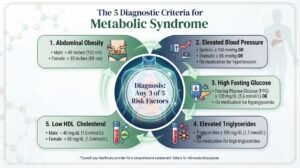
Metabolic syndrome after 50 refers to a cluster of metabolic abnormalities that occur together and substantially increase the risk of cardiovascular disease and type 2 diabetes.
According to major medical organizations, a diagnosis is generally made when an individual presents at least three of the following five risk factors:
Although each condition can occur independently, their coexistence reflects widespread metabolic dysfunction that affects nearly every organ system.
The prevalence of metabolic syndrome after 50 increases steadily with age, largely because hormonal changes, reduced muscle mass, sedentary lifestyles, and excess visceral fat become more common during midlife and older adulthood.
Rather than being viewed as an inevitable consequence of aging, metabolic syndrome should be understood as an early warning sign that lifestyle interventions are urgently needed.
Several physiological changes make adults over 50 more susceptible to metabolic dysfunction.
As we age, cells gradually become less responsive to insulin. The pancreas compensates by producing more insulin, but over time this process may become unsustainable, increasing the risk of prediabetes and type 2 diabetes.
Unlike subcutaneous fat that lies beneath the skin, visceral fat accumulates around internal organs and actively releases inflammatory compounds that interfere with metabolism.
Age-related sarcopenia reduces the body’s ability to use glucose efficiently because skeletal muscle is one of the primary sites for glucose disposal.
Declining estrogen in women and gradual testosterone reduction in men contribute to increased abdominal fat, changes in body composition, and reduced metabolic efficiency.
Persistent inflammation—often called inflammaging—impairs insulin signaling and promotes cardiovascular disease.
Together, these changes explain why metabolic syndrome after 50 has become increasingly common worldwide.
Many people with metabolic syndrome after 50 feel perfectly healthy.
Unfortunately, symptoms often appear only after years of silent damage.
Excess waist circumference is usually the earliest visible sign.
Visceral fat surrounding the liver, pancreas, and intestines is metabolically active and contributes to inflammation, insulin resistance, and hormonal imbalance.
Elevated blood pressure places continuous strain on arteries and the heart.
Without treatment, hypertension significantly increases the risk of:
High fasting glucose often develops gradually.
Early insulin resistance may produce few noticeable symptoms while progressively damaging blood vessels.
High triglycerides frequently accompany insulin resistance and excessive carbohydrate intake.
They increase cardiovascular risk and often occur alongside fatty liver disease.
HDL helps transport excess cholesterol away from arteries.
Lower HDL levels reduce this protective effect and contribute to plaque formation.
One of the greatest concerns about metabolic syndrome after 50 is that its complications often develop silently over many years.
Each metabolic abnormality reinforces the others, creating a cycle that accelerates biological aging and increases the likelihood of multiple chronic diseases.
People with metabolic syndrome are significantly more likely to experience:
Because hypertension, insulin resistance, abnormal cholesterol, and chronic inflammation often coexist, the cardiovascular system is continuously exposed to damage.
For more information, read How to Prevent Heart Disease After 50 (https://liveeverbetter.com/prevent-heart-disease-after-50/).
Insulin resistance is considered the metabolic hallmark of metabolic syndrome after 50.
As insulin becomes less effective, the pancreas compensates by producing increasingly larger amounts of the hormone.
Eventually, insulin production may no longer keep pace with demand, allowing blood glucose levels to rise into the diabetic range.
Early intervention can often prevent this progression.
Learn more in How to Improve Insulin Sensitivity After 50 Naturally.
Excess visceral fat and insulin resistance commonly lead to non-alcoholic fatty liver disease (NAFLD).
Over time, fat accumulation inside liver cells may progress to inflammation, fibrosis, cirrhosis, and liver failure.
Fortunately, weight loss and improved metabolic health can significantly reduce liver fat in many individuals.
Visceral fat functions as an active endocrine organ.
It continuously releases inflammatory cytokines that contribute to:
Reducing inflammation is therefore a central strategy for reversing metabolic syndrome after 50.
Read Chronic Inflammation: Causes, Symptoms & How to Reduce It Naturally.
Growing evidence links metabolic syndrome with reduced brain health.
High blood sugar, vascular damage, inflammation, and hypertension may impair blood flow to the brain, increasing the risk of:
Protecting metabolic health also helps preserve long-term cognitive function.
The encouraging news is that metabolic syndrome after 50 is highly responsive to lifestyle changes.
Many people experience meaningful improvements without requiring complex interventions.
Reducing abdominal fat is often the single most effective intervention.
Even losing 5–10% of body weight can improve:
Visceral fat responds particularly well to regular exercise and improved nutrition.
Read How to Lose Visceral Fat After 50 Naturally.
The Mediterranean diet consistently demonstrates benefits for nearly every component of metabolic syndrome.
Its emphasis on whole foods naturally reduces inflammation while improving lipid profiles and insulin sensitivity.
Key foods include:
Highly processed foods, sugary beverages, refined carbohydrates, and processed meats should be minimized.
Learn more in Mediterranean Diet for Healthy Aging.
Strength training increases muscle mass, one of the body’s largest sites for glucose utilization.
More muscle improves:
Experts recommend resistance training at least two to three times per week.
Read Strength Training After 50.
Walking remains one of the safest and most sustainable forms of exercise for adults over 50.
Daily walking helps:
Even brisk walking for 30 minutes most days produces measurable metabolic benefits.
Read Walking and Longevity.
Poor sleep disrupts hormones that regulate:
Adults consistently sleeping seven to nine hours generally demonstrate better metabolic health than those experiencing chronic sleep deprivation.
Read Sleep and Healthy Aging and How to Sleep Better After 50 Naturally.
Long-term success comes from consistency rather than perfection.
Simple daily habits—including healthy eating, movement, hydration, stress management, and preventive healthcare—work together to improve every component of metabolic syndrome after 50.
Read Daily Habits to Stay Healthy After 50.
One of the most encouraging facts about metabolic syndrome after 50 is that, unlike many chronic diseases, it can often be significantly improved—and in some individuals even reversed—through consistent lifestyle changes.
The earlier intervention begins, the greater the chance of restoring metabolic health before irreversible damage occurs.
Clinical studies consistently demonstrate that improving body composition, increasing physical activity, and adopting healthier eating patterns can normalize several components of metabolic syndrome simultaneously.
Rather than focusing on a single laboratory value, the goal should be improving overall metabolic function.
Metabolic syndrome after 50 develops through a combination of aging, excess visceral fat, insulin resistance, chronic inflammation, physical inactivity, poor nutrition, hormonal changes, genetics, and inadequate sleep. These factors interact over many years, gradually impairing metabolic health.
No.
Metabolic syndrome is a cluster of risk factors that greatly increases the likelihood of developing type 2 diabetes and cardiovascular disease.
Many people with metabolic syndrome do not yet have diabetes, making early intervention especially valuable.
In many cases, yes.
Weight loss, improved nutrition, regular strength training, walking, better sleep, stress reduction, and improved insulin sensitivity can substantially improve—or even normalize—the individual components of metabolic syndrome after 50.
Research shows that losing approximately 5–10% of total body weight often produces meaningful improvements in:
Even relatively modest weight reduction can significantly lower long-term disease risk.
No.
While abdominal obesity is one of the strongest indicators, a diagnosis of metabolic syndrome after 50 generally requires at least three metabolic abnormalities.
However, excess waist circumference alone deserves attention because it strongly predicts future metabolic dysfunction.
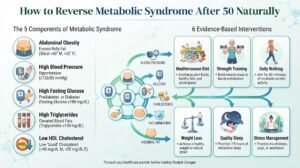
Developing metabolic syndrome after 50 is not an inevitable consequence of aging.
Instead, it serves as an early warning that your metabolism needs attention. The combination of abdominal obesity, elevated blood pressure, abnormal cholesterol, high triglycerides, and impaired blood sugar regulation dramatically increases the risk of heart disease, stroke, type 2 diabetes, and many other chronic conditions.
Fortunately, metabolic syndrome after 50 responds remarkably well to healthy lifestyle changes. Improving nutrition, reducing visceral fat, increasing physical activity, building muscle, sleeping better, and managing stress can reverse many of the underlying mechanisms responsible for metabolic dysfunction.
The most important step is to begin before complications develop. Small, sustainable improvements practiced consistently over months and years can profoundly improve both lifespan and healthspan.
• National Heart, Lung, and Blood Institute. What Is Metabolic Syndrome?
Read the resource → https://www.nhlbi.nih.gov/health/metabolic-syndrome
• American Heart Association. Metabolic Syndrome.
Read the guide → https://www.heart.org/en/health-topics/metabolic-syndrome
• International Diabetes Federation. The IDF Consensus Worldwide Definition of the Metabolic Syndrome.
Read the publication → https://idf.org/
• Alberti KGMM, et al. Harmonizing the Metabolic Syndrome. Circulation.
Read the study → https://pubmed.ncbi.nlm.nih.gov/19805654/
• Grundy SM. Metabolic Syndrome Update. Trends in Cardiovascular Medicine.
Read the publication → https://pubmed.ncbi.nlm.nih.gov/
• World Health Organization. Cardiovascular Diseases (CVDs).
Read the publication → https://www.who.int/news-room/fact-sheets/detail/cardiovascular-diseases-(cvds)
The information provided in this article is for educational purposes only and should not be considered medical advice. Always consult a qualified healthcare professional before making changes to your diet, exercise routine, medications, or supplement use. Never disregard professional medical advice or delay seeking it because of something you have read on this website.

The Live Ever Better Editorial Team is dedicated to publishing evidence-based content that helps adults over 50 achieve healthier aging and greater longevity. Every article is carefully researched using scientific studies, clinical guidelines, and trusted health organizations to ensure accurate, practical, and reliable health information.