Physical Address
304 North Cardinal St.
Dorchester Center, MA 02124
If you’ve been searching for how to reduce your biological age naturally, you’ve probably realized that modern longevity science is changing the way we think about aging.
For decades, people assumed aging was simply the unavoidable consequence of getting older. Today, scientists know the story is far more complex. While no one can stop chronological aging, research suggests that the biological processes driving aging can be influenced by daily lifestyle choices.
In other words, two people born on exactly the same day can have dramatically different biological ages.
One may remain physically active, mentally sharp, and metabolically healthy well into their seventies. The other may develop chronic diseases decades earlier.
The difference isn’t luck.
In many cases, it’s the result of thousands of small decisions repeated over many years.
Learning how to reduce your biological age naturally isn’t about finding a miracle supplement or following the latest anti-aging trend. It’s about understanding the biological systems that influence aging and supporting them through evidence-based habits.
This guide explains what biological age actually means, why it matters more than chronological age, how scientists measure it, and the practical lifestyle strategies that can help you maintain a younger, healthier body for longer.
Understanding how to reduce your biological age naturally begins with recognizing that healthy aging is influenced far more by daily habits than by any single medical treatment or supplement.
In this article
ToggleChronological age measures the number of years since birth.
Biological age measures something much more important:
How well your body is aging.
Scientists evaluate biological age using biomarkers that reflect the condition of your organs, muscles, cardiovascular system, metabolism, immune system, and brain.
These biomarkers often include:
Someone who is 65 years old chronologically may have the biological profile of a healthy 55-year-old—or, unfortunately, someone much older.
This is why researchers increasingly study how to reduce your biological age naturally as one of the most promising approaches to extending healthspan rather than simply increasing lifespan.
Imagine two identical twins.
Both celebrate their 60th birthday today.
Twin A:
Twin B:
Although both twins share the same chronological age, decades of research suggest their biological ages may differ significantly.
One body has aged more slowly.
The other has accumulated greater physiological wear and tear.
This difference is exactly what biological age attempts to measure.
This is perhaps the most common question in longevity science.
The honest answer is nuanced.
You cannot reverse time.
However, accumulating evidence suggests you may improve many of the biological markers used to estimate biological age.
Researchers have shown that interventions involving:
can positively influence biomarkers associated with biological aging.
Some studies using epigenetic clocks even suggest measurable improvements after sustained lifestyle interventions.
While scientists continue studying these findings, there is broad agreement on one point:
Healthy habits slow biological aging.
Although no intervention can stop time, the growing body of evidence supporting how to reduce your biological age naturally continues to expand as researchers better understand the biology of aging.
Living longer isn’t enough.
What most people truly want is to remain:
This is known as healthspan.
Healthspan refers to the years of life spent in good health.
Longevity science increasingly focuses on extending healthspan—not merely lifespan.
Learning how to reduce your biological age naturally is ultimately about preserving quality of life.
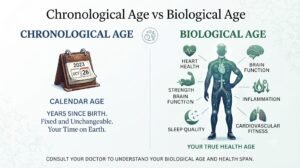
Unlike chronological age, biological age cannot be determined by looking at a birth certificate. Instead, researchers evaluate a combination of biomarkers that reflect how well the body is functioning.
No single test tells the whole story. Rather, biological age is estimated by examining multiple physiological systems working together.
Among the most commonly used measurements are:
More advanced research also uses DNA methylation, often called epigenetic clocks, to estimate biological age at the cellular level.
These tools continue to improve and are helping scientists better understand how to reduce your biological age naturally through lifestyle interventions rather than medications alone.
No single habit slows aging by itself.
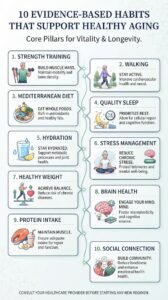
Instead, healthy aging results from multiple systems working together. Think of these habits as pieces of the same puzzle. The more consistently they are practiced, the greater their combined impact on your long-term health.
One of the strongest predictors of healthy aging is not body weight.
It’s muscle.
Beginning around age 30, adults gradually lose muscle mass and strength unless they actively work to preserve it. This process, known as sarcopenia, accelerates after age 50 and contributes to frailty, insulin resistance, falls, reduced mobility, and loss of independence.
Resistance training stimulates muscle protein synthesis, improves metabolic health, and increases functional capacity.
Studies consistently show that stronger adults experience lower rates of chronic disease and mortality.
Learning how to reduce your biological age naturally almost always begins with protecting lean muscle mass.
Learn how to get started with Strength Training After 50.
If there is one biomarker that repeatedly predicts longevity, it is VO₂ max.
VO₂ max measures your body’s ability to deliver and use oxygen during exercise.
Higher cardiorespiratory fitness is associated with:
Even moderate improvements in aerobic fitness can significantly reduce biological aging over time.
Walking, cycling, swimming, jogging, and interval training all contribute to improving VO₂ max.
Read our complete guide on VO₂ Max and Longevity.
Nutrition influences nearly every biological process involved in aging.
Among all dietary patterns studied, the Mediterranean diet consistently ranks among the healthiest for promoting longevity.
Its emphasis on:
helps reduce chronic inflammation while supporting cardiovascular and brain health.
Highly processed foods, excessive sugar, and refined carbohydrates tend to have the opposite effect.
Adopting healthier eating habits is one of the most practical ways of learning how to reduce your biological age naturally.
Learn more in Mediterranean Diet for Healthy Aging.
Because it does.
Sleep is when the body repairs tissues, regulates hormones, consolidates memory, and removes metabolic waste from the brain.
Chronic sleep deprivation has been linked to:
Most adults over 50 benefit from seven to nine hours of quality sleep every night.
Sleep consistency often matters just as much as sleep duration.
Discover practical strategies in Sleep and Healthy Aging.
Exercise sessions matter.
But so does everything that happens between them.
People who remain physically active throughout the day generally experience healthier aging than those who exercise for one hour and remain sedentary for the other twenty-three.
Simple daily movement includes:
Regular movement improves circulation, glucose control, joint mobility, and cardiovascular health.
Daily movement reinforces many of the mechanisms involved in how to reduce your biological age naturally, especially when combined with structured exercise.
Explore the benefits of Walking and Longevity.
Scientists often describe aging as a state of low-grade chronic inflammation, sometimes called inflammaging.
Persistent inflammation contributes to:
Lifestyle factors that reduce inflammation include:
Reducing chronic inflammation is another important component of how to reduce your biological age naturally.
Protein becomes increasingly important with age.
Older adults require adequate protein intake to preserve muscle mass, maintain immune function, and support recovery.
Many experts recommend distributing protein evenly throughout the day instead of consuming most of it at dinner.
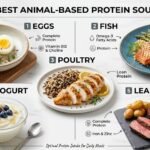
Excellent protein sources include:
Learn more in Protein After 50.
Short-term stress is a normal part of life.
Chronic stress is not.
Persistent activation of the stress response increases cortisol levels, disrupts sleep, impairs immunity, raises blood pressure, and contributes to metabolic dysfunction.
Healthy stress-management strategies include:
Managing stress effectively helps protect multiple biological systems involved in healthy aging.
A healthy brain is one of the clearest signs of healthy aging.
Cognitive decline is not an inevitable consequence of growing older. While some changes in memory and processing speed occur naturally with age, research suggests that many of the major risk factors for dementia are modifiable.
Supporting brain health involves a combination of lifestyle habits, including:
Scientists increasingly recognize that what benefits the heart often benefits the brain as well.
If your goal is how to reduce your biological age naturally, protecting cognitive function should be just as important as maintaining muscle strength or cardiovascular fitness.
Learn more in Brain Health After 50.
You can also explore our guide on How to Prevent Dementia Naturally.
The greatest predictor of long-term success isn’t intensity.
It’s consistency.
Many people search for quick fixes that promise to reverse aging in weeks. In reality, biological aging responds to habits practiced over years rather than dramatic short-term interventions.
Instead of attempting to change everything at once, focus on small improvements that become permanent parts of your lifestyle.
Examples include:
Every healthy decision sends a positive signal to your body’s biological systems.
Over time, these signals accumulate.
That’s why learning how to reduce your biological age naturally is less about chasing perfection and more about building routines that last.
This is one of the fastest-growing areas of longevity research.
Although no supplement has been proven to “reverse aging,” some nutrients may support healthy biological aging when combined with an overall healthy lifestyle.
Among the most studied are:
These nutrients support muscle function, brain health, cardiovascular health, bone strength, and metabolic processes that naturally decline with age.
However, supplements should complement—not replace—a healthy diet, regular exercise, and quality sleep.
Learn more:
There is no universal timeline.
Some biomarkers, such as blood pressure, blood sugar, sleep quality, and physical fitness, may improve within weeks or months.
Others, including body composition, muscle strength, and certain epigenetic markers, often require sustained lifestyle changes over longer periods.
The important point is not to chase rapid results.
Healthy aging is a lifelong process.
Consistently practicing the habits described in this guide gives your body the best opportunity to age more slowly while preserving function and independence.
Research suggests that healthy lifestyle habits can improve many of the biomarkers used to estimate biological age. While you cannot reverse chronological time, consistent improvements in exercise, nutrition, sleep, and metabolic health may positively influence biological aging.
Chronological age is simply the number of years you’ve lived. Biological age reflects how well your body is functioning based on physiological and molecular markers.
There is no single shortcut. The greatest benefits come from combining regular physical activity, resistance training, healthy nutrition, quality sleep, stress management, and avoiding smoking.
Yes. Both aerobic exercise and strength training are consistently associated with healthier biological aging, improved cardiovascular fitness, preserved muscle mass, and lower mortality risk.
Many researchers believe biological age provides a more meaningful picture of long-term health because it reflects how well the body’s systems are functioning rather than simply the passage of time.
Understanding how to reduce your biological age naturally changes the way we think about aging.
Rather than viewing aging as something that simply happens to us, modern longevity science shows that many aspects of biological aging respond to everyday choices. While genetics play an important role, the habits you repeat each day have a profound influence on how your body functions over time.
Protecting muscle mass, improving cardiovascular fitness, eating a nutrient-rich diet, sleeping well, managing stress, and staying physically active are not isolated recommendations—they are interconnected strategies that help preserve healthspan and reduce the risk of chronic disease.
The encouraging message is that it’s never too late to begin. Whether you’re in your forties, fifties, sixties, or beyond, adopting evidence-based lifestyle habits can improve your overall health and support healthier aging.
Learning how to reduce your biological age naturally is ultimately about investing in your future self. Every healthy choice you make today contributes to building a stronger, more resilient body for the years ahead.
• Belsky DW, et al. Quantification of the Pace of Biological Aging in Humans through a Blood Test (DunedinPACE). Nature Aging.
Read the study → https://pubmed.ncbi.nlm.nih.gov/35027778/
• Levine ME, et al. An epigenetic biomarker of aging for lifespan and healthspan. Aging (Albany NY).
Read the study → https://pubmed.ncbi.nlm.nih.gov/29676998/
• Horvath S. DNA methylation age of human tissues and cell types. Genome Biology.
Read the study → https://pubmed.ncbi.nlm.nih.gov/24138928/
• National Institute on Aging. What Is Healthy Aging?
Read the resource → https://www.nia.nih.gov/health/healthy-aging
• World Health Organization. Decade of Healthy Ageing (2021–2030).
Read the report → https://www.who.int/initiatives/decade-of-healthy-ageing
• American College of Sports Medicine. Exercise and Physical Activity for Older Adults.
Read the position statement → https://pubmed.ncbi.nlm.nih.gov/27304504/
The information provided in this article is for educational purposes only and should not be considered medical advice. Always consult a qualified healthcare professional before making changes to your diet, exercise routine, medications, or supplement use. Never disregard professional medical advice or delay seeking it because of something you have read on this website.
The Live Ever Better Editorial Team is dedicated to publishing evidence-based content that helps adults over 50 achieve healthier aging and greater longevity. Every article is carefully researched using scientific studies, clinical guidelines, and trusted health organizations to ensure accurate, practical, and reliable health information.