Physical Address
304 North Cardinal St.
Dorchester Center, MA 02124
Physical Address
304 North Cardinal St.
Dorchester Center, MA 02124
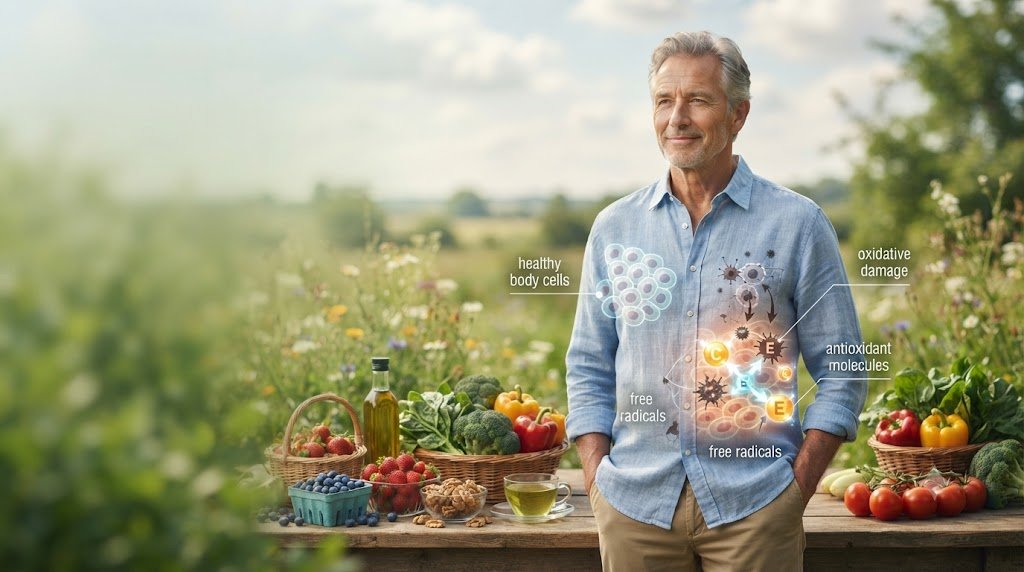
Aging is a natural biological process, but not all aging occurs at the same pace. One of the most important mechanisms influencing how quickly our cells age is oxidative stress after 50. Over time, oxidative damage accumulates throughout the body, affecting the heart, brain, muscles, immune system, and virtually every organ.
Oxidative stress occurs when unstable molecules called free radicals outnumber the body’s natural antioxidant defenses. While free radicals are produced as a normal part of metabolism, excessive amounts can damage DNA, proteins, cell membranes, and mitochondria, accelerating biological aging and increasing the risk of chronic disease.
The encouraging news is that oxidative stress after 50 is strongly influenced by lifestyle. Healthy nutrition, regular exercise, quality sleep, stress management, and avoiding harmful habits can significantly reduce oxidative damage while supporting healthier aging.
In this evidence-based guide, you’ll learn what oxidative stress after 50 really is, why it increases with age, how it affects your health, and the science-backed strategies that naturally strengthen your body’s antioxidant defenses.
Understanding oxidative stress after 50 begins with understanding free radicals.
Free radicals are unstable molecules produced naturally during everyday metabolic processes, including:
Because they contain unpaired electrons, free radicals are highly reactive. They seek stability by interacting with nearby molecules, which can damage healthy cells if antioxidant defenses become overwhelmed.
Normally, the body maintains a balance between free radicals and antioxidants.
Oxidative stress develops when:
This imbalance contributes to progressive cellular damage that accumulates over many years.
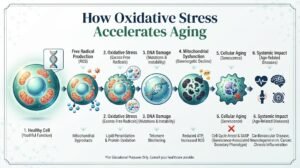
Several biological changes make oxidative stress after 50 increasingly common.
As we age, the body’s ability to produce its own protective antioxidant enzymes gradually declines.
These enzymes include:
Lower activity of these systems allows oxidative damage to accumulate more rapidly.
Mitochondria generate the majority of cellular energy.
However, they also produce free radicals as a natural byproduct of energy production.
Over time, aging mitochondria become less efficient and generate larger amounts of reactive oxygen species (ROS), further increasing oxidative stress after 50.
Inflammation and oxidative stress reinforce one another.
Persistent low-grade inflammation stimulates additional free radical production, while oxidative damage further activates inflammatory pathways.
Learn more in Chronic Inflammation: Causes, Symptoms & How to Reduce It Naturally.
Throughout life, exposure accumulates from:
These exposures contribute to lifelong oxidative damage.
Several everyday behaviors can significantly increase oxidative stress, including:
Fortunately, these are also among the most modifiable risk factors.
The most common contributors include:
Highly processed foods rich in refined carbohydrates, trans fats, and added sugars provide fewer protective antioxidants while increasing inflammation.
Cigarette smoke introduces thousands of oxidizing chemicals directly into the body.
Smoking remains one of the strongest contributors to oxidative damage.
Excess visceral fat continuously produces inflammatory molecules that stimulate free radical production.
Read How to Lose Visceral Fat After 50 Naturally.
Long-term stress increases cortisol production and may contribute to greater oxidative damage.
Sleep is one of the body’s primary recovery periods.
Insufficient sleep reduces cellular repair while increasing inflammatory activity.
Read:
Conditions such as:
are strongly associated with elevated oxidative stress.
Read:
Oxidative stress influences nearly every biological system involved in aging.
Research suggests it contributes to:
These effects increase vulnerability to numerous age-related diseases while gradually reducing healthspan.
Although oxidative stress after 50 is a normal part of aging, excessive oxidative damage has been associated with many chronic diseases.
Researchers believe oxidative stress interacts with inflammation, genetics, metabolism, and environmental factors to influence disease development over time.
Oxidative damage contributes to the oxidation of LDL cholesterol, one of the key processes involved in atherosclerosis.
Oxidized LDL is more likely to accumulate within artery walls, increasing the risk of:
Lowering oxidative stress supports healthier blood vessels and cardiovascular function.
Read How to Prevent Heart Disease After 50.
The brain consumes large amounts of oxygen, making it particularly vulnerable to oxidative damage.
Over many years, excessive oxidative stress may contribute to:
Scientists continue investigating how antioxidant-rich lifestyles may help preserve cognitive health during aging.
High blood glucose increases free radical production.
In turn, oxidative stress worsens insulin resistance, creating a cycle that promotes metabolic dysfunction.
Reducing oxidative stress may improve insulin sensitivity alongside healthy nutrition and exercise.
Read:
Oxidative stress and inflammation continuously reinforce each other.
Free radicals activate inflammatory pathways, while inflammatory cells generate additional free radicals.
Breaking this cycle is one of the primary goals of healthy aging.
Read Chronic Inflammation: Causes, Symptoms & How to Reduce It Naturally (https://liveeverbetter.com/chronic-inflammation/).
Loss of muscle mass with aging is influenced by multiple factors.
Oxidative damage may reduce muscle protein synthesis while impairing mitochondrial function inside muscle cells.
Regular resistance training helps counter many of these effects.
Read Strength Training After 50.
Fortunately, oxidative stress after 50 responds remarkably well to healthy lifestyle habits.
Rather than relying on one supplement, experts recommend combining several evidence-based strategies.
Colorful fruits and vegetables contain thousands of naturally occurring antioxidants.
Different colors provide different protective compounds.
Examples include:
The broader the variety of plant foods, the greater the diversity of protective phytochemicals.
The Mediterranean diet consistently ranks among the healthiest eating patterns for reducing oxidative stress.
It emphasizes:
Together, these foods provide antioxidants, healthy fats, and anti-inflammatory compounds.
Read Mediterranean Diet for Healthy Aging.
Moderate exercise may temporarily increase free radical production during activity.
However, regular training strengthens the body’s natural antioxidant defense systems over time.
This adaptation makes cells more resistant to oxidative damage.
The best combination includes:
Read:
Deep sleep allows the body to repair oxidative damage accumulated throughout the day.
Poor sleep is consistently associated with:
Read:
Visceral fat contributes to both oxidative stress and chronic inflammation.
Losing excess abdominal fat reduces the production of inflammatory molecules while improving metabolic health.
Read How to Lose Visceral Fat After 50 Naturally.
Smoking exposes the body to an enormous number of oxidizing chemicals.
Quitting smoking remains one of the most effective ways to reduce oxidative damage and improve long-term health.
Highly processed foods often contain fewer protective antioxidants while promoting inflammation and metabolic dysfunction.
Replacing them with minimally processed whole foods supports healthier cellular function.
Long-term stress increases cortisol production and contributes to oxidative damage.
Helpful strategies include:
A healthy gut microbiome helps regulate inflammation and may indirectly reduce oxidative stress.
A fiber-rich diet together with fermented foods supports microbial diversity.
Read Leaky Gut After 50: Symptoms, Causes and Proven Ways to Heal Naturally.
Healthy aging results from consistent daily behaviors rather than isolated interventions.
Small improvements practiced over many years have a profound cumulative effect on reducing oxidative stress.
Read Daily Habits to Stay Healthy After 50.
Many people assume that antioxidant supplements automatically reduce oxidative stress.
The scientific evidence is more nuanced.
For most healthy adults, obtaining antioxidants through whole foods appears more beneficial than relying on high-dose supplements.
Whole foods contain hundreds of naturally occurring compounds that work together in ways isolated supplements cannot fully replicate.
Supplementation may be appropriate in certain situations, but it should be individualized and discussed with a qualified healthcare professional.
Oxidative stress after 50 occurs when the body produces more free radicals than its antioxidant defense systems can neutralize.
Over time, this imbalance contributes to cellular damage that may accelerate biological aging and increase the risk of chronic diseases.
Yes.
Some degree of oxidative stress naturally occurs throughout life because free radicals are produced during normal metabolism.
However, healthy lifestyle habits can significantly reduce excessive oxidative damage and help preserve cellular function as we age.
Foods naturally rich in antioxidants include:
Eating a wide variety of plant foods provides numerous antioxidant compounds that work together to protect cells.
Temporarily, yes.
Exercise naturally increases free radical production during activity.
However, regular exercise also strengthens the body’s own antioxidant defense systems, making cells more resistant to oxidative damage over time.
This beneficial adaptation is one reason physical activity is consistently associated with healthier aging.
Not for most healthy adults.
Current evidence suggests that obtaining antioxidants from a balanced diet rich in whole foods provides greater benefits than taking high-dose antioxidant supplements.
Supplements may be appropriate in specific clinical situations but should be discussed with a healthcare professional.
Understanding oxidative stress after 50 helps explain one of the fundamental biological processes behind aging itself.
Every day, our cells produce free radicals as part of normal metabolism. The goal is not to eliminate these molecules entirely—they also play important roles in immune defense and cellular communication—but rather to maintain a healthy balance between free radicals and antioxidants.
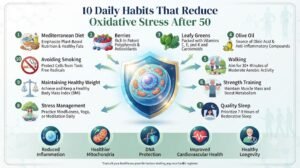
The encouraging news is that many of the habits already known to support healthy aging are also the most effective ways to reduce oxidative stress. A Mediterranean-style diet rich in colorful fruits and vegetables, regular physical activity, restorative sleep, stress management, maintaining a healthy weight, and avoiding smoking all strengthen the body’s natural antioxidant defenses.
Instead of searching for a single “anti-aging” solution, focus on consistently supporting your body’s remarkable ability to repair and protect itself. Reducing oxidative stress after 50 is not about stopping aging—it is about aging healthier, preserving cellular function, and maximizing your healthspan for years to come.
• National Institute on Aging. The Biology of Aging.
Read the resource → https://www.nia.nih.gov/health/biology-aging
• Harvard T.H. Chan School of Public Health. The Nutrition Source.
Read the guide → https://www.hsph.harvard.edu/nutritionsource/
• World Health Organization. Ageing and Health.
Read the publication → https://www.who.int/news-room/fact-sheets/detail/ageing-and-health
• Liguori I, et al. Oxidative Stress, Aging, and Diseases. Clinical Interventions in Aging.
Read the study → https://pubmed.ncbi.nlm.nih.gov/26640395/
• Finkel T, Holbrook NJ. Oxidants, Oxidative Stress and the Biology of Ageing. Nature.
Read the publication → https://pubmed.ncbi.nlm.nih.gov/11753480/
• Sies H. Oxidative Stress: A Concept in Redox Biology and Medicine. Redox Biology.
Read the study → https://pubmed.ncbi.nlm.nih.gov/25460731/
The information provided in this article is for educational purposes only and should not be considered medical advice. Always consult a qualified healthcare professional before making changes to your diet, exercise routine, medications, or supplement use. Never disregard professional medical advice or delay seeking it because of something you have read on this website.

The Live Ever Better Editorial Team is dedicated to publishing evidence-based content that helps adults over 50 achieve healthier aging and greater longevity. Every article is carefully researched using scientific studies, clinical guidelines, and trusted health organizations to ensure accurate, practical, and reliable health information.