Physical Address
304 North Cardinal St.
Dorchester Center, MA 02124
Physical Address
304 North Cardinal St.
Dorchester Center, MA 02124
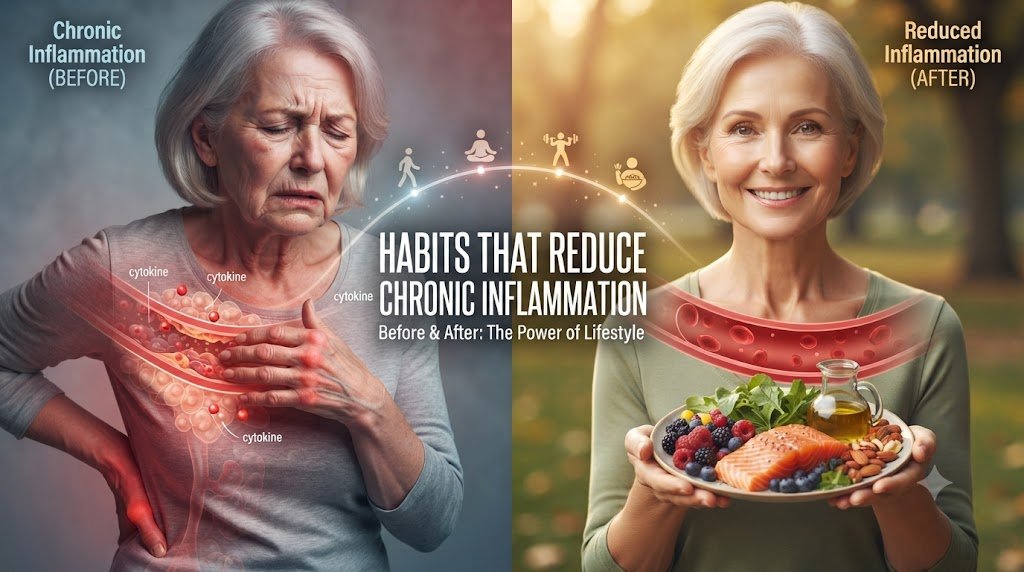
If you’ve heard the term chronic inflammation after 50, you may wonder why doctors and longevity researchers consider it one of the greatest threats to healthy aging.
Unlike the short-term inflammation that helps your body heal after an injury or infection, chronic inflammation after 50 is a low-grade, persistent immune response that can silently damage tissues and organs for years. Scientists often refer to this process as inflammaging—a combination of inflammation and aging.
Inflammaging doesn’t usually cause obvious symptoms at first. Instead, it slowly contributes to conditions such as heart disease, type 2 diabetes, Alzheimer’s disease, osteoporosis, arthritis, sarcopenia, and many other age-related disorders.
The encouraging news is that chronic inflammation after 50 is strongly influenced by lifestyle. Everyday choices—including what you eat, how well you sleep, how active you are, and how you manage stress—can either increase or decrease inflammatory activity throughout your body.
In this evidence-based guide, you’ll learn what causes chronic inflammation after 50, why it matters for longevity, and the most effective science-backed strategies to reduce inflammaging naturally.
Inflammation is your body’s natural defense system.
When you cut your finger or catch a virus, your immune system activates inflammatory cells to repair damaged tissue and eliminate harmful invaders.
This acute inflammation is healthy and necessary.
The problem occurs when the inflammatory response never fully turns off.
With chronic inflammation after 50, the immune system remains mildly activated even without injury or infection. Over months and years, this persistent inflammatory state damages blood vessels, muscles, joints, nerves, and organs.
Researchers now recognize chronic inflammation after 50 as one of the central mechanisms behind biological aging.
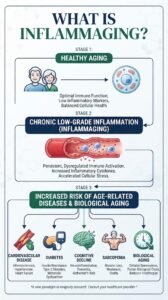
Inflammaging describes the chronic, low-grade inflammation that develops gradually as we grow older.
Rather than being caused by a single disease, inflammaging results from multiple interacting factors, including:
Unlike acute inflammation, inflammaging progresses silently for years before symptoms become noticeable.
Understanding chronic inflammation after 50 helps explain why healthy lifestyle habits influence so many different diseases simultaneously.
Several biological changes contribute to higher inflammatory activity with age.
These include:
Each of these factors can amplify chronic inflammation after 50, accelerating biological aging if left unaddressed.
Persistent inflammation affects nearly every organ system.
Higher levels of inflammatory markers have been associated with:
Because inflammation influences so many conditions, reducing chronic inflammation after 50 often improves overall health rather than targeting a single disease.
To better understand biological aging, read How to Reduce Your Biological Age Naturally.
One of the most effective ways to reduce chronic inflammation after 50 is improving your daily diet.
Foods consistently associated with lower inflammation include:
These foods provide antioxidants, polyphenols, fiber, and healthy fats that help regulate inflammatory pathways throughout the body.
The Mediterranean dietary pattern remains one of the best-studied approaches for lowering inflammation and supporting healthy aging.
Learn more in:
Excess body fat—particularly visceral fat—is one of the strongest contributors to chronic inflammation after 50.
Visceral fat is metabolically active. Rather than simply storing energy, it releases inflammatory molecules known as cytokines that keep the immune system in a constant state of activation.
Even modest reductions in abdominal fat have been shown to decrease inflammatory markers and improve metabolic health.
If you’re carrying excess belly fat, reducing it is one of the most effective ways to lower chronic inflammation after 50.
Continue reading:
Regular physical activity is one of the most powerful anti-inflammatory interventions known.
Exercise helps:
Both aerobic exercise and resistance training contribute to reducing chronic inflammation after 50, but combining the two appears to provide the greatest benefits.
Aim for:
Learn more in:
Sleep is when your body performs much of its repair and recovery.
Chronic sleep deprivation increases inflammatory markers, disrupts hormone regulation, and weakens immune function.
Adults over 50 who consistently sleep fewer than seven hours per night often show higher levels of systemic inflammation.
Improving sleep quality is one of the simplest ways to reduce chronic inflammation after 50.
Helpful habits include:
Continue reading:
Muscle tissue is much more than a structure that allows movement.
Healthy muscles release compounds called myokines, which have anti-inflammatory effects throughout the body.
Unfortunately, muscle mass naturally declines with age—a condition known as sarcopenia.
Preserving lean muscle through resistance training and adequate protein intake helps counteract chronic inflammation after 50 while supporting mobility, balance, and metabolic health.
Learn more in:
Stress is a normal part of life, but persistent psychological stress can significantly increase inflammatory activity.
Long-term elevations in cortisol alter immune regulation and promote chronic low-grade inflammation.
Healthy stress-management strategies include:
Managing stress effectively is another important component of reducing chronic inflammation after 50.
The trillions of microorganisms living in your digestive tract help regulate immune function.
An unhealthy gut microbiome—known as dysbiosis—has been linked to increased inflammation and many chronic diseases.
Supporting gut health includes:
Improving gut health is an indirect yet powerful strategy for lowering chronic inflammation after 50.
Learn more in:
Repeated spikes in blood sugar contribute to oxidative stress and chronic inflammation.
Keeping glucose levels stable helps reduce inflammatory damage throughout the body.
Helpful strategies include:
Improving blood sugar regulation is central to reducing chronic inflammation after 50 because inflammation and insulin resistance reinforce one another.
Learn more in:
Smoking dramatically increases oxidative stress and inflammatory activity.
Likewise, excessive alcohol intake damages the liver, disrupts the gut microbiome, and promotes systemic inflammation.
If you smoke, quitting remains one of the most impactful actions you can take to reduce chronic inflammation after 50.
When drinking alcohol, moderation is key.
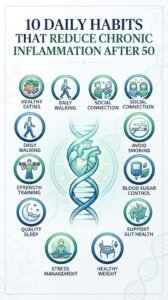
Perhaps the greatest mistake people make is searching for a single “anti-inflammatory” food or supplement.
There is no magic solution.
Lowering chronic inflammation after 50 results from the combined effect of consistent daily habits.
These include:
Small habits, repeated consistently, create powerful long-term benefits for both lifespan and healthspan.
Unlike acute inflammation, chronic inflammation often develops silently.
Possible signs include:
However, many people experience no obvious symptoms.
Healthcare providers may evaluate inflammatory activity using blood tests such as C-reactive protein (CRP) alongside other clinical assessments.
The most common contributors include aging, excess visceral fat, poor diet, physical inactivity, chronic stress, inadequate sleep, smoking, insulin resistance, and changes in the gut microbiome.
Some increase in inflammatory activity occurs naturally with age, but excessive chronic inflammation after 50 is not inevitable. Healthy lifestyle habits can substantially reduce inflammaging and improve overall health.
Foods consistently associated with lower inflammation include:
These foods form the foundation of many anti-inflammatory dietary patterns.
Yes.
Regular physical activity is one of the most effective non-pharmaceutical strategies for reducing chronic inflammation after 50. Both aerobic exercise and strength training contribute to healthier immune regulation.
Some supplements—including omega-3 fatty acids and certain evidence-supported compounds—may help in specific situations. However, supplements should complement—not replace—a healthy diet, regular exercise, quality sleep, and other lifestyle habits.
Understanding chronic inflammation after 50 may be one of the most important things you can do to protect your long-term health.
Unlike infections or injuries that trigger short-term inflammation, chronic low-grade inflammation quietly affects nearly every organ system. Over time, it accelerates biological aging, damages blood vessels, weakens muscles, impairs brain function, disrupts metabolism, and increases the risk of many of the chronic diseases commonly associated with aging.
The encouraging news is that chronic inflammation after 50 is not simply an unavoidable consequence of getting older.
Research consistently shows that inflammation is highly responsive to lifestyle.
Simple daily habits—eating a Mediterranean-style diet, maintaining a healthy body weight, walking regularly, strength training, sleeping well, managing stress, and supporting a healthy gut microbiome—work together to lower inflammation and improve overall health.
There is no single food, supplement, or medication capable of eliminating inflammaging on its own.
Instead, the greatest benefits come from combining multiple healthy behaviors into a sustainable lifestyle.
The goal isn’t merely to reduce inflammation.
It’s to improve your healthspan—the number of years you remain healthy, active, independent, and mentally sharp.
Every healthy choice you make today helps reduce chronic inflammation after 50, slows biological aging, and increases the likelihood of living a longer, healthier, and more fulfilling life.
• National Institute on Aging. Chronic Inflammation and Aging.
Read the resource → https://www.nia.nih.gov
• Harvard T.H. Chan School of Public Health. The Nutrition Source: Inflammation.
Read the guide → https://www.hsph.harvard.edu/nutritionsource/
• World Health Organization. Ageing and Health.
Read the publication → https://www.who.int/news-room/fact-sheets/detail/ageing-and-health
• Furman D, et al. Chronic Inflammation in the Etiology of Disease Across the Life Span. Nature Medicine.
Read the study → https://pubmed.ncbi.nlm.nih.gov/29643481/
• Franceschi C, Campisi J. Chronic Inflammation (Inflammaging) and Its Potential Contribution to Age-Associated Diseases. The Journals of Gerontology.
Read the publication → https://pubmed.ncbi.nlm.nih.gov/24833586/
• Calder PC, et al. Dietary Factors and Low-Grade Inflammation in Relation to Overweight and Obesity. British Journal of Nutrition.
Read the study → https://pubmed.ncbi.nlm.nih.gov/
The information provided in this article is for educational purposes only and should not be considered medical advice. Always consult a qualified healthcare professional before making changes to your diet, exercise routine, medications, or supplement use. Never disregard professional medical advice or delay seeking it because of something you have read on this website.

The Live Ever Better Editorial Team is dedicated to publishing evidence-based content that helps adults over 50 achieve healthier aging and greater longevity. Every article is carefully researched using scientific studies, clinical guidelines, and trusted health organizations to ensure accurate, practical, and reliable health information.