Physical Address
304 North Cardinal St.
Dorchester Center, MA 02124
Physical Address
304 North Cardinal St.
Dorchester Center, MA 02124

Many adults notice that maintaining energy becomes increasingly difficult after the age of 50. Tasks that once felt effortless may require more recovery, exercise can become more challenging, and fatigue may appear even after a full night’s sleep. While these changes are influenced by many factors, one of the most important is the gradual decline in mitochondrial health after 50.
Mitochondria are often called the powerhouses of the cell because they produce adenosine triphosphate (ATP), the molecule that supplies energy for nearly every biological process. Every heartbeat, muscle contraction, nerve impulse, and immune response depends on healthy mitochondria functioning efficiently.
As we age, mitochondria naturally become less efficient. They produce less ATP, generate more reactive oxygen species (ROS), and become more vulnerable to oxidative damage. This decline contributes not only to lower energy levels but also to reduced muscle strength, slower metabolism, impaired cognitive performance, and increased risk of chronic disease.
Fortunately, mitochondrial health after 50 is highly responsive to lifestyle. Scientific evidence shows that nutrition, regular exercise, quality sleep, stress management, and maintaining metabolic health all help preserve mitochondrial function and promote healthier aging.
In this evidence-based guide, you’ll learn why mitochondrial health after 50 matters, what causes mitochondria to decline with age, and the proven strategies that naturally support cellular energy production.
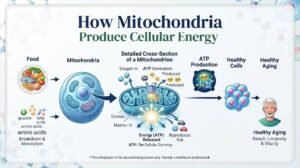
Understanding mitochondrial health after 50 begins with understanding what mitochondria actually do.
Mitochondria are tiny structures found inside nearly every cell in the body. Their primary role is converting nutrients from food into ATP through a process known as cellular respiration.
ATP powers virtually every biological function, including:
Because organs such as the heart, brain, liver, and skeletal muscles require enormous amounts of energy, they contain particularly high numbers of mitochondria.
Healthy mitochondria continuously adapt to the body’s energy demands. They can increase in number, improve efficiency, repair themselves, and even remove damaged mitochondria through a quality-control process called mitophagy.
Several biological mechanisms contribute to reduced mitochondrial health after 50.
Throughout life, mitochondria naturally produce reactive oxygen species during ATP generation.
Over decades, these free radicals gradually damage:
This damage reduces mitochondrial efficiency while increasing additional oxidative stress.
Learn more in Oxidative Stress After 50: Causes, Symptoms and Proven Ways to Reduce It Naturally.
The body continuously creates new mitochondria through a process called mitochondrial biogenesis.
After age 50, this process slows, meaning damaged mitochondria are replaced less efficiently.
Lifestyle habits strongly influence this process, particularly regular physical activity.
Persistent low-grade inflammation interferes with mitochondrial function.
Inflammatory molecules impair energy production while increasing oxidative damage inside mitochondria.
Read Chronic Inflammation: Causes, Symptoms & How to Reduce It Naturally (https://liveeverbetter.com/chronic-inflammation/).
Cells affected by insulin resistance often struggle to efficiently use glucose for energy.
This places additional stress on mitochondria and contributes to reduced ATP production.
Read:
Muscles respond to regular exercise by creating more mitochondria.
Conversely, prolonged inactivity reduces both mitochondrial number and function.
Even moderate daily movement significantly benefits mitochondrial health after 50.
Mitochondrial dysfunction develops gradually and often overlaps with normal aging.
Although these symptoms have many possible causes, reduced mitochondrial efficiency may contribute to:
Because these symptoms are nonspecific, they should always be discussed with a healthcare professional rather than attributed solely to mitochondrial decline.
Healthy mitochondria influence nearly every major system involved in longevity.
Research suggests that preserving mitochondrial health after 50 may help support:
Scientists increasingly consider mitochondrial dysfunction one of the central biological hallmarks of aging.
The encouraging news is that mitochondrial health after 50 is remarkably adaptable. Unlike many aspects of aging that cannot be changed, mitochondria respond continuously to healthy lifestyle choices.
Scientific research consistently shows that daily habits can stimulate the formation of new mitochondria, improve their efficiency, and protect them from oxidative damage.
Physical activity is considered one of the most effective interventions for improving mitochondrial health after 50.
When muscles contract during exercise, they signal the body to produce more mitochondria through mitochondrial biogenesis. Over time, this increases the muscles’ capacity to generate ATP efficiently.
The most beneficial exercise routine combines:
Read:
Mitochondria require a constant supply of nutrients to function efficiently.
The Mediterranean diet provides healthy fats, antioxidants, vitamins, minerals, and plant compounds that help protect mitochondrial membranes while reducing oxidative stress.
Foods particularly beneficial include:
Read Mediterranean Diet for Healthy Aging.
Oxidative stress damages mitochondria over time.
Consuming antioxidant-rich foods helps reduce this damage and supports healthier cellular function.
Excellent choices include:
Learn more in Oxidative Stress After 50: Causes, Symptoms and Proven Ways to Reduce It Naturally.
Most mitochondrial repair occurs while we sleep.
During deep sleep, cells repair damaged proteins, remove dysfunctional mitochondria through mitophagy, and restore energy balance.
Adults over 50 should aim for consistent, high-quality sleep every night.
Read:
Healthy mitochondria depend on healthy metabolism.
Conditions such as insulin resistance, obesity, and metabolic syndrome place additional stress on mitochondria while reducing ATP production.
Improving metabolic health also improves mitochondrial efficiency.
Read:
Persistent inflammation damages mitochondria while interfering with energy production.
Lowering chronic inflammation helps preserve mitochondrial function throughout aging.
Read Chronic Inflammation: Causes, Symptoms & How to Reduce It Naturally.
Smoking dramatically increases oxidative stress and accelerates mitochondrial damage.
Quitting smoking remains one of the most effective ways to protect long-term cellular health.
Excess visceral fat increases inflammatory signaling and oxidative stress, both of which impair mitochondrial function.
Losing excess abdominal fat supports healthier energy production.
Read How to Lose Visceral Fat After 50 Naturally.
Long-term stress increases cortisol production and may negatively affect mitochondrial function.
Helpful stress-management strategies include:
Reducing chronic stress benefits both energy levels and overall longevity.
Healthy mitochondria are the result of long-term consistency rather than short-term interventions.
Small daily improvements accumulate over years, helping preserve cellular energy production well into older adulthood.
Read Daily Habits to Stay Healthy After 50.
Several dietary supplements are marketed specifically for mitochondrial support.
Among the most studied are:
Although some studies show promising results in specific populations, current scientific evidence does not support routine supplementation for all healthy adults.
Experts generally agree that lifestyle interventions—including nutrition, exercise, sleep, and metabolic health—have far stronger and more consistent effects on mitochondrial health after 50 than supplements alone.
Future research will continue clarifying which individuals may benefit most from targeted mitochondrial supplementation.
Mitochondria are tiny structures found inside almost every cell in the body. They convert nutrients from food into adenosine triphosphate (ATP), the molecule that provides energy for virtually all cellular activities.
Because organs such as the heart, brain, liver, and muscles require enormous amounts of energy, they contain particularly high concentrations of mitochondria.
Several natural aging processes contribute to declining mitochondrial health after 50, including:
Although some decline is expected with age, healthy lifestyle habits can significantly slow this process.
Yes.
Exercise is one of the strongest natural stimulators of mitochondrial biogenesis.
Regular physical activity encourages the body to produce new mitochondria while improving the efficiency of existing ones.
This is one reason consistent exercise is associated with:
A nutrient-dense dietary pattern supports healthier mitochondria.
Helpful foods include:
These foods provide antioxidants, healthy fats, vitamins, minerals, and plant compounds that help protect mitochondria from oxidative damage.
Not for most healthy adults.
Although supplements such as CoQ10 and nicotinamide riboside continue to be studied, current evidence suggests that maintaining healthy lifestyle habits has a much greater impact on mitochondrial health after 50 than supplementation alone.
Individuals considering supplements should consult a qualified healthcare professional.
Healthy aging depends on healthy cells—and healthy cells depend on healthy mitochondria.
Because mitochondria generate the energy required for every heartbeat, muscle contraction, immune response, and brain function, preserving mitochondrial health after 50 is one of the most important investments you can make for your long-term health.
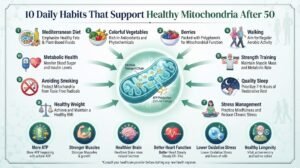
While mitochondrial function naturally changes with age, research consistently demonstrates that lifestyle has a powerful influence on how well these cellular powerhouses continue to perform. Regular exercise, a Mediterranean-style diet, quality sleep, maintaining a healthy weight, reducing chronic inflammation, managing stress, and avoiding smoking all help protect mitochondrial function and improve cellular energy production.
Rather than searching for a single supplement or “anti-aging” solution, focus on building daily habits that support your body’s natural ability to generate energy efficiently. Strengthening mitochondrial health after 50 not only improves vitality today but also lays the foundation for better physical function, cognitive performance, metabolic health, and longevity in the years ahead.
• National Institute on Aging. The Biology of Aging.
Read the resource → https://www.nia.nih.gov/health/biology-aging
• Harvard T.H. Chan School of Public Health. The Nutrition Source.
Read the guide → https://www.hsph.harvard.edu/nutritionsource/
• World Health Organization. Ageing and Health.
Read the publication → https://www.who.int/news-room/fact-sheets/detail/ageing-and-health
• Picard M, McEwen BS. Psychological Stress and Mitochondria: A Systematic Review. Psychosomatic Medicine.
Read the study → https://pubmed.ncbi.nlm.nih.gov/30585865/
• Sun N, Youle RJ, Finkel T. The Mitochondrial Basis of Aging. Molecular Cell.
Read the publication → https://pubmed.ncbi.nlm.nih.gov/27508823/
• López-Otín C, et al. The Hallmarks of Aging. Cell.
Read the landmark paper → https://pubmed.ncbi.nlm.nih.gov/23746838/
The information provided in this article is for educational purposes only and should not be considered medical advice. Always consult a qualified healthcare professional before making changes to your diet, exercise routine, medications, or supplement use. Never disregard professional medical advice or delay seeking it because of something you have read on this website.

The Live Ever Better Editorial Team is dedicated to publishing evidence-based content that helps adults over 50 achieve healthier aging and greater longevity. Every article is carefully researched using scientific studies, clinical guidelines, and trusted health organizations to ensure accurate, practical, and reliable health information.